Bishop's Simplified Method
Bishop's Simplified Method is a widely used limit equilibrium technique for analyzing slope stability, especially suitable for circular slip surfaces. It improves on the Ordinary Method of Slices by including interslice normal forces and satisfies both moment and vertical force equilibrium. On circular surfaces its factor of safety is typically very close to the rigorous Spencer value, which makes it a dependable choice for routine design and a convenient check on Spencer; its main restriction is that it applies only to circular slip surfaces. The key assumptions are:
- Circular slip surface
- Interslice side forces are horizontal and the moments they create are negligible
- Satisfies:
- Moment equilibrium
- Vertical force equilibrium
- Does not satisfy horizontal force equilibrium
With these assumptions, the forces acting on the slice are as follows:
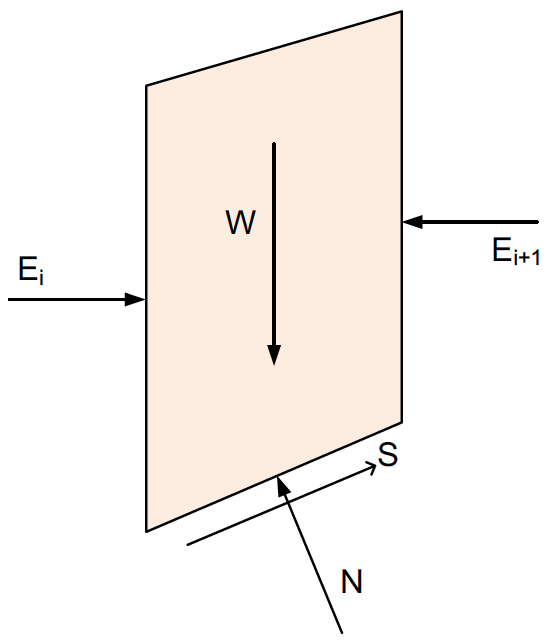
Where:
\(W\) = weight of the slice
\(\alpha\) = base inclination angle of the slice
\(\Delta \ell\) = length of the base
\(c', \phi'\) = effective cohesion and friction angle
\(u\) = pore water pressure
\(N\) = normal force on the base of the slice
\(S\) = shear force at the base
Recall that:
\(N = N' + u \Delta \ell\)
\(N' = N - u \Delta \ell\)
Where \(N'\) is the effective normal stress on the base of the slice.
Summing forces in the vertical direction:
\(\sum F_y = 0\)
\(N \cos \alpha + S \sin \alpha - W = 0\)
\((N' + u \Delta \ell) \cos \alpha + S \sin \alpha - W = 0\)
\(N' \cos \alpha + u \Delta \ell \cos \alpha + S \sin \alpha - W = 0 \qquad (1)\)
Where \(S\) is the mobilized shear force at the base of the slice. The shear force is given by:
\(S = \dfrac{1}{F} \left[c \Delta \ell + N' \tan \phi' \right] \qquad (2)\)
Substituting (2) into (1):
\(N' \cos \alpha + u \Delta \ell \cos \alpha + \dfrac{1}{F} \left[ c \Delta \ell + N' \tan \phi' \right] \sin \alpha - W = 0\)
Now solve for the effective normal force \(N'\). First, we rearrange the equation:
\(N' \cos \alpha + u \Delta \ell \cos \alpha + \dfrac{c \Delta \ell}{F} \sin \alpha + \dfrac{N' \tan \phi'}{F} \sin \alpha - W = 0\)
Next, we isolate all terms involving \(N'\):
\(N' \cos \alpha + \dfrac{N' \tan \phi'}{F} \sin \alpha = W - u \Delta \ell \cos \alpha - \dfrac{c \Delta \ell}{F} \sin \alpha\)
\(N' \left( \cos \alpha + \dfrac{\sin \alpha \tan \phi'}{F} \right) = W - u \Delta \ell \cos \alpha - \dfrac{c \Delta \ell}{F} \sin \alpha\)
Finally, we can solve for \(N'\):
\(N' = \dfrac{W - u \Delta \ell \cos \alpha - \dfrac{c \Delta \ell}{F} \sin \alpha}{\cos \alpha + \dfrac{\sin \alpha \tan \phi'}{F}} \qquad (3)\)
Next we use the general equation for the factor of safety based on moment equilibrium (resisting moments divided by driving moments):
\(F = \dfrac{\sum (c + \sigma' \tan \phi') \Delta \ell}{\sum W \sin \alpha}\)
\(N' = \sigma' \Delta \ell\)
thus:
\(F = \dfrac{\sum (c \Delta \ell + N' \tan \phi')}{\sum W \sin \alpha} \qquad (4)\)
Next, we substitute (3) into (4):
\(F = \dfrac{\sum \left[ c \Delta \ell + \left( \dfrac{W - u \Delta \ell \cos \alpha - \dfrac{c \Delta \ell}{F} \sin \alpha}{\cos \alpha + \dfrac{\sin \alpha \tan \phi'}{F}} \right) \tan \phi' \right]}{\sum W \sin \alpha}\)
To simplify the numerator, we multiply \(c \Delta \ell\) by \(\dfrac{\cos \alpha + \dfrac{\sin \alpha \tan \phi'}{F}}{\cos \alpha + \dfrac{\sin \alpha \tan \phi'}{F}}\) to combine like terms:
\(F = \dfrac{\sum \left[ \dfrac{c \Delta \ell (\cos \alpha + \dfrac{\sin \alpha \tan \phi'}{F}) + (W - u \Delta \ell \cos \alpha - \dfrac{c \Delta \ell}{F} \sin \alpha) \tan \phi'}{\cos \alpha + \dfrac{\sin \alpha \tan \phi'}{F}} \right]}{\sum W \sin \alpha}\)
Now we rearrange the numerator:
\(F = \dfrac{\sum \left[ \dfrac{c \Delta \ell \cos \alpha + \dfrac{c \Delta \ell}{F} \sin \alpha \tan \phi' + (W - u \Delta \ell \cos \alpha) \tan \phi' - \dfrac{c \Delta \ell}{F} \sin \alpha \tan \phi'}{\cos \alpha + \dfrac{\sin \alpha \tan \phi'}{F}} \right]}{\sum W \sin \alpha}\)
Finally, the \(\dfrac{c \Delta \ell}{F} \sin \alpha \tan \phi'\) terms cancel out, leading to:
\(F = \dfrac{\sum \left[ \dfrac{c \Delta \ell \cos \alpha + (W - u \Delta \ell \cos \alpha) \tan \phi'}{\cos \alpha + \dfrac{\sin \alpha \tan \phi'}{F}} \right]}{\sum W \sin \alpha} \qquad (5)\)
Which is the standard equation for the factor of safety for Bishop's method.
The factor of safety \(F\) appears on both sides of the equation, so it must be solved iteratively.
Once \(F\) is determined, \(N'\) can be computed using equation (3) above.
Complete Formulation
For a complete implementation of Bishop's Simplified Method, we need to consider additional forces acting on the slice. The full set of forces are shown in the following figure:
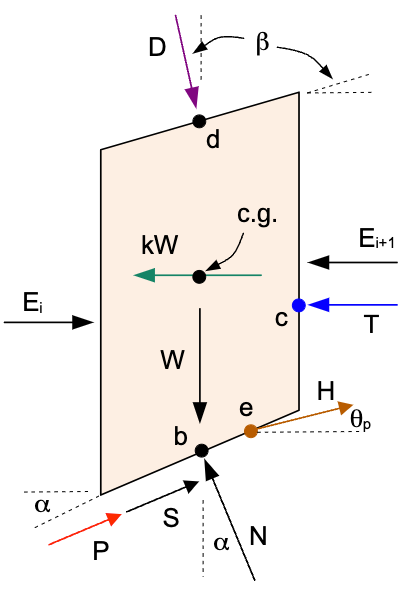
Where:
\(D\) = distributed load resultant force
\(\beta\) = inclination of the distributed load (perpendicular to slope)
\(kW\) = seismic force for pseudo-static seismic analysis
\(c.g.\) = center of gravity of the slice
\(P\) = reinforcement force at point \(r\) on the base of the slice, at angle \(\psi\) from horizontal (\(\psi = \alpha\) for tangent/flexible reinforcement, the default; \(\psi\) = the line's own inclination for axial/rigid reinforcement)
\(T\) = tension crack water force
\(H\) = pile/pier force at point \(e\) on the failure surface
\(\theta_p\) = angle of pile force from horizontal (positive = counterclockwise/upward)
\(L\) = line load at point \(f\) on the top of the slice, at angle \(\delta\) from horizontal (default \(-90°\) = straight down)
⚠ TODO (figures): redraw the force diagram above in LibreOffice Draw — show \(P\) at a general angle \(\psi\) applied at point \(r\) (not tangent to the base), and add the line load \(L\) at angle \(\delta\) at point \(f\) on the top of the slice.
Each of these forces is described in detail in the Ordinary Method of Slices (OMS) section. The forces \(D\), \(kW\), \(P\), \(T\), \(H\), and \(L\) are included in the Bishop's method factor of safety equation as follows:
Vertical Force Equilibrium
First we need to consider how these forces affect the vertical force equilibrium. The vertical force equilibrium equation becomes:
\(N \cos \alpha + S \sin \alpha + P \sin \psi + H \sin \theta_p + L \sin \delta - W - D \cos \beta = 0\)
\((N' + u \Delta \ell) \cos \alpha + S \sin \alpha + P \sin \psi + H \sin \theta_p + L \sin \delta - W - D \cos \beta = 0\)
\(N' \cos \alpha + u \Delta \ell \cos \alpha + S \sin \alpha + P \sin \psi + H \sin \theta_p + L \sin \delta - W - D \cos \beta = 0 \qquad (6)\)
The shear force on the base of the slice remains the same as before:
\(S = \dfrac{1}{F} \left[c \Delta \ell + N' \tan \phi' \right] \qquad (7)\)
Substituting (7) into (6) and solving for N':
\(N' \cos \alpha + u \Delta \ell \cos \alpha + \dfrac{1}{F} \left[c \Delta \ell + N' \tan \phi' \right] \sin \alpha + P \sin \psi + H \sin \theta_p + L \sin \delta - W - D \cos \beta = 0\)
\(N' \cos \alpha + u \Delta \ell \cos \alpha + \dfrac{1}{F} c \Delta \ell \sin \alpha + \dfrac{1}{F} N' \tan \phi' \sin \alpha + P \sin \psi + H \sin \theta_p + L \sin \delta - W - D \cos \beta = 0\)
\(N' \cos \alpha + \dfrac{1}{F} N' \tan \phi' \sin \alpha = W + D \cos \beta - P \sin \psi - H \sin \theta_p - L \sin \delta - u \Delta \ell \cos \alpha - \dfrac{1}{F} c \Delta \ell \sin \alpha\)
\(N' \left( \cos \alpha + \dfrac{\sin \alpha \tan \phi'}{F} \right) = W + D \cos \beta - P \sin \psi - H \sin \theta_p - L \sin \delta - u \Delta \ell \cos \alpha - \dfrac{1}{F} c \Delta \ell \sin \alpha\)
Finally, we can solve for \(N'\):
\(N' = \dfrac{W + D \cos \beta - P \sin \psi - H \sin \theta_p - L \sin \delta - u \Delta \ell \cos \alpha - \dfrac{c \Delta \ell}{F} \sin \alpha}{\cos \alpha + \dfrac{\sin \alpha \tan \phi'}{F}} \qquad (8)\)
Moment Equilibrium
The moment equilibrium equation about the center of the slip circle must also be revised to include the moments from the additional forces. The mobilized shear force is \(S_{mob} = S/F\), where \(S = c \Delta \ell + N' \tan \phi'\) is the full shear strength. The reinforcement force \(P\) (when Appl = Active, the default), the pile force \(H\), and the line load \(L\) are known applied forces and are not factored by \(F\); a Passive reinforcement force instead joins the mobilized side and is divided by \(F\). For Dir = Tangent (\(\psi = \alpha\)) the reinforcement acts tangent to the circle with moment arm exactly \(R\), so its component terms below collapse to \(R \sum P\); the component form is required for Dir = Axial. Taking moments about the center of the circle:
\(R \sum \dfrac{S}{F} + \sum \left[ P \cos \psi \, a_{ry} + P \sin \psi \, a_{rx} \right] + \sum D \sin \beta \, a_{dy} + \sum \left[ H \cos \theta_p \, a_{ey} + H \sin \theta_p \, a_{ex} \right] + \sum \left[ L \cos \delta \, a_{fy} + L \sin \delta \, a_{fx} \right] = R \sum W \sin \alpha + \sum D \cos \beta \, a_{dx} + k\sum W \, a_s + T \, a_t \qquad (9)\)
Where:
\(a_{dx}\) = horizontal distance from center of circle to point \(d\)
\(a_{dy}\) = vertical distance from center of circle to point \(d\)
\(a_s\) = vertical distance from center of circle to center of gravity of the slice
\(a_t\) = vertical distance from center of circle to point \(c\)
\(a_{ey}\) = vertical distance from center of circle to point \(e\): \(Y_o - y_e\)
\(a_{ex}\) = horizontal distance from center of circle to point \(e\): \(x_e - X_o\)
The pile force \(H\) is decomposed into horizontal (\(H \cos \theta_p\)) and vertical (\(H \sin \theta_p\)) components, each with its own moment arm about the circle center.
Isolating the shear term on the left side:
\(R \sum \dfrac{S}{F} = R \sum W \sin \alpha + \sum D \cos \beta \, a_{dx} + k\sum W \, a_s + T \, a_t - \sum \left[ P \cos \psi \, a_{ry} + P \sin \psi \, a_{rx} \right] - \sum D \sin \beta \, a_{dy} - \sum \left[ H \cos \theta_p \, a_{ey} + H \sin \theta_p \, a_{ex} \right] - \sum \left[ L \cos \delta \, a_{fy} + L \sin \delta \, a_{fx} \right]\)
Dividing by \(R\):
\(\dfrac{1}{F} \sum S = \sum W \sin \alpha + \frac{1}{R}\sum D \cos \beta \, a_{dx} + \frac{k}{R}\sum W \, a_s + \frac{1}{R} T \, a_t - \frac{1}{R}\sum \left[ P \cos \psi \, a_{ry} + P \sin \psi \, a_{rx} \right] - \frac{1}{R}\sum D \sin \beta \, a_{dy} - \frac{1}{R}\sum \left[ H \cos \theta_p \, a_{ey} + H \sin \theta_p \, a_{ex} \right] - \frac{1}{R}\sum \left[ L \cos \delta \, a_{fy} + L \sin \delta \, a_{fx} \right]\)
Solving for \(F\):
\(F = \dfrac{\sum S}{\sum W \sin \alpha + \frac{1}{R}\sum D \cos \beta \, a_{dx} + \frac{k}{R}\sum W \, a_s + \frac{1}{R} T \, a_t - \frac{1}{R}\sum \left[ P \cos \psi \, a_{ry} + P \sin \psi \, a_{rx} \right] - \frac{1}{R}\sum D \sin \beta \, a_{dy} - \frac{1}{R}\sum \left[ H \cos \theta_p \, a_{ey} + H \sin \theta_p \, a_{ex} \right] - \frac{1}{R}\sum \left[ L \cos \delta \, a_{fy} + L \sin \delta \, a_{fx} \right]}\)
Substituting \(S = c \Delta \ell + N' \tan \phi'\):
\(F = \dfrac{\sum \left( c \Delta \ell + N' \tan \phi' \right)}{\sum W \sin \alpha + \frac{1}{R}\sum D \cos \beta \, a_{dx} + \frac{k}{R}\sum W \, a_s + \frac{1}{R} T \, a_t - \frac{1}{R}\sum \left[ P \cos \psi \, a_{ry} + P \sin \psi \, a_{rx} \right] - \frac{1}{R}\sum D \sin \beta \, a_{dy} - \frac{1}{R}\sum \left[ H \cos \theta_p \, a_{ey} + H \sin \theta_p \, a_{ex} \right] - \frac{1}{R}\sum \left[ L \cos \delta \, a_{fy} + L \sin \delta \, a_{fx} \right]}\)
Substituting (8) for \(N'\):
\(F = \dfrac{\sum \left(c \Delta \ell + \left[ \dfrac{W + D \cos \beta - P \sin \psi - H \sin \theta_p - L \sin \delta - u \Delta \ell \cos \alpha - \dfrac{c \Delta \ell}{F} \sin \alpha}{\cos \alpha + \dfrac{\sin \alpha \tan \phi'}{F}} \right] \tan \phi' \right)}{\sum W \sin \alpha + \frac{1}{R}\sum D \cos \beta \, a_{dx} + \frac{k}{R}\sum W \, a_s + \frac{1}{R} T \, a_t - \frac{1}{R}\sum \left[ P \cos \psi \, a_{ry} + P \sin \psi \, a_{rx} \right] - \frac{1}{R}\sum D \sin \beta \, a_{dy} - \frac{1}{R}\sum \left[ H \cos \theta_p \, a_{ey} + H \sin \theta_p \, a_{ex} \right] - \frac{1}{R}\sum \left[ L \cos \delta \, a_{fy} + L \sin \delta \, a_{fx} \right]}\)
To simplify the numerator, we multiply \(c \Delta \ell\) by \(\dfrac{\cos \alpha + \dfrac{\sin \alpha \tan \phi'}{F}}{\cos \alpha + \dfrac{\sin \alpha \tan \phi'}{F}}\):
\(F = \dfrac{\sum \left[ \dfrac{c \Delta \ell (\cos \alpha + \dfrac{\sin \alpha \tan \phi'}{F}) + (W + D \cos \beta - P \sin \psi - H \sin \theta_p - L \sin \delta - u \Delta \ell \cos \alpha) \tan \phi' - \dfrac{c \Delta \ell}{F} \sin \alpha \tan \phi'}{\cos \alpha + \dfrac{\sin \alpha \tan \phi'}{F}} \right]}{\sum W \sin \alpha + \frac{1}{R}\sum D \cos \beta \, a_{dx} + \frac{k}{R}\sum W \, a_s + \frac{1}{R} T \, a_t - \frac{1}{R}\sum \left[ P \cos \psi \, a_{ry} + P \sin \psi \, a_{rx} \right] - \frac{1}{R}\sum D \sin \beta \, a_{dy} - \frac{1}{R}\sum \left[ H \cos \theta_p \, a_{ey} + H \sin \theta_p \, a_{ex} \right] - \frac{1}{R}\sum \left[ L \cos \delta \, a_{fy} + L \sin \delta \, a_{fx} \right]}\)
Now, we can rearrange the numerator:
\(F = \dfrac{\sum \left[ \dfrac{c \Delta \ell \cos \alpha + \dfrac{c \Delta \ell}{F} \sin \alpha \tan \phi' + (W + D \cos \beta - P \sin \psi - H \sin \theta_p - L \sin \delta - u \Delta \ell \cos \alpha) \tan \phi' - \dfrac{c \Delta \ell}{F} \sin \alpha \tan \phi'}{\cos \alpha + \dfrac{\sin \alpha \tan \phi'}{F}} \right]}{\sum W \sin \alpha + \frac{1}{R}\sum D \cos \beta \, a_{dx} + \frac{k}{R}\sum W \, a_s + \frac{1}{R} T \, a_t - \frac{1}{R}\sum \left[ P \cos \psi \, a_{ry} + P \sin \psi \, a_{rx} \right] - \frac{1}{R}\sum D \sin \beta \, a_{dy} - \frac{1}{R}\sum \left[ H \cos \theta_p \, a_{ey} + H \sin \theta_p \, a_{ex} \right] - \frac{1}{R}\sum \left[ L \cos \delta \, a_{fy} + L \sin \delta \, a_{fx} \right]}\)
Finally, the \(\dfrac{c\Delta\ell}{F} \sin \alpha \tan \phi'\) terms cancel out, leading to:
\(F = \dfrac{\sum \left[ \dfrac{c \Delta \ell \cos \alpha + (W + D \cos \beta - P \sin \psi - H \sin \theta_p - L \sin \delta - u \Delta \ell \cos \alpha) \tan \phi'}{\cos \alpha + \dfrac{\sin \alpha \tan \phi'}{F}} \right]}{\sum W \sin \alpha + \frac{1}{R}\sum D \cos \beta \, a_{dx} + \frac{k}{R}\sum W \, a_s + \frac{1}{R} T \, a_t - \frac{1}{R}\sum \left[ P \cos \psi \, a_{ry} + P \sin \psi \, a_{rx} \right] - \frac{1}{R}\sum D \sin \beta \, a_{dy} - \frac{1}{R}\sum \left[ H \cos \theta_p \, a_{ey} + H \sin \theta_p \, a_{ex} \right] - \frac{1}{R}\sum \left[ L \cos \delta \, a_{fy} + L \sin \delta \, a_{fx} \right]} \qquad (10)\)
This is the complete formulation for Bishop's Simplified Method. Note that:
- The reinforcement force \(P\), the pile force \(H\), and the distributed load resisting moment \(D \sin \beta\, a_{dy}\) appear in the denominator because they are known forces that are not factored by the safety factor \(F\)
- \(P\) and \(H\) affect the numerator indirectly through their effect on \(N'\)
- The water force \(T\) only applies to the uppermost slice
The factor of safety \(F\) appears on both sides of the equation, so it must be solved iteratively, just like the basic formulation.
Composite Surfaces
Bishop's moment equation, like the OMS equation, factors out a constant radius \(R\) and drops the base normal on the grounds that it points at the center of rotation. Both steps assume every slice base lies on the circle. On a composite surface — a circle truncated at bedrock, running along the floor between the crossings — they do not, and XSLOPE substitutes the general moment arms derived in Ordinary Method of Slices:
\(F = \dfrac{\sum \left( c \Delta \ell + N' \tan \phi \right) a_S}{\sum W x_r - \sum \left( N' + u \Delta \ell \right) a_N + \sum D \cos \beta \, a_{dx} + k \sum W \, a_s + T \, a_t - \ldots}\)
with \(a_S = x_r \sin \alpha - y_r \cos \alpha\) and \(a_N = x_r \cos \alpha + y_r \sin \alpha\), both measured from the center of rotation. On a true circle \(a_S = R\) and \(a_N = 0\), recovering the equation above exactly.
One difference from OMS: \(N'\) in Bishop comes from vertical equilibrium and so depends on \(F\), which means the normal-force moment \(\sum (N' + u \Delta \ell)\, a_N\) is itself part of the iteration. It is recomputed inside the fixed-point loop rather than once up front. The expression for \(N'\) (equation 11) is unaffected — it comes from vertical equilibrium of a single slice, which knows nothing about the shape of the surface as a whole.
Summary
Assumes horizontal side forces
Satisfies moment and vertical force equilibrium
Applicable to circular and composite slip surfaces
Requires iteration to solve for \(F\)
More accurate than OMS, especially for effective stress analysis with high pore pressures