GeoStudio (SLOPE/W) Verification Corpus
The GeoStudio slope stability verification manual (Seequent) contains 47 verification problems solved with SLOPE/W. Many are the same published benchmarks as the Rocscience corpus above, which makes the manual doubly useful: its geometry figures are coordinate-labeled where Slide's sometimes are not (it supplied the ACADS 1(c) interfaces and the inclined ACADS 4 seam above), and its SLOPE/W numbers give an independent second program to compare against. Where a problem coincides with a built Rocscience entry, the row below points at the same XSLOPE input file — those files are already regression-tagged in the table above, so no tags are duplicated here. XSLOPE's Janbu carries the fo correction; SLOPE/W's "Janbu" column is the uncorrected force solution, so those columns are compared via the correction factor where noted.
Full bibliographic details for the author-year citations on this page are on the shared References page.
Building these problems
Most of the entries below were built by transcribing the manual's geometry figures by hand. The few rows that are not built are held up by a strength model XSLOPE does not yet have (§2.47) or a measured pressure grid with no flow field to regenerate (§2.10) — not by a missing source document.
That is no longer the only route. Seequent publishes the models behind the manual, not just the figures, on a public CDN — no login, no license:
https://files.seequent.com/GeoStudio/SlopeW/<Manual Section Name>.gsz
Confirmed for e.g. ACADS Simple Slope, ACADS External Load, Prandtl Bearing Capacity, Tandjiria Geosynthetic Reinforced Embankment, Sheahan Amhearst Soil Nails and Cannon Dam.
XSLOPE reads them directly — see GeoStudio Import/Export — so a problem's exact geometry and material properties arrive with no transcription step, which removes the ambiguity blocking the remaining rows:
from xslope.geostudio import read_gsz, list_analyses, gsz_to_slope_data

gsz = read_gsz("ACADS Simple Slope.gsz")
for a in list_analyses(gsz):
    print(a["id"], a["name"], a["method"])

slope_data, caveats = gsz_to_slope_data(gsz, analysis_id=1)
That also changes what "verification" can mean here. A solved .gsz records SLOPE/W's factor of safety for
every trial surface it evaluated, not just the critical one — several hundred per analysis — along with the
weight of each sliding mass. So XSLOPE can be run on the identical surfaces and the two programs compared with
no difference in search to explain away. See Importer verification below.
The model files are Seequent's, and stay Seequent's
The .gsz files are Seequent's copyrighted material. XSLOPE links to them and reads them; it does not
redistribute them, and none are committed to this repository. Import them yourself from the links above if
you want to reproduce this work. The XSLOPE .xlsx inputs derived from the published problem data are ours,
and are published here as usual.
Importer verification
Verifying the importer is a different job from verifying the solver, and it needs a different rig. Reading a
.gsz back through XSLOPE's own reader proves nothing — a reader and a writer that share the same wrong idea of
the schema agree perfectly with each other. So the importer is scored against SLOPE/W's own answers: import
the model, re-solve every trial circle SLOPE/W saved, and compare, with the surface and the method held fixed.
The rig is tools/gsz_corpus.py (it takes a path to a local folder of .gsz files, which are not
redistributable and so are not in the repo).
Two numbers are reported per analysis, and the split is what makes it diagnostic:
- weight — XSLOPE's sliding mass against the weight SLOPE/W recorded for the same surface. This tests the imported polygons, the material assignment and the unit weights with the solver taken out of the way.
- FS — the whole model: strengths, pore pressure, loads, cracks, reinforcement.
A geometry bug moves both. A strength, water or load bug moves only the second.
| Model | Analysis | Surfaces | Weight | FS | Within 1% |
|---|---|---|---|---|---|
| ACADS Simple Slope | a. simple slope | 355 | +0.19% | −0.10% | 91% |
| ACADS Simple Slope | b. tension crack | 152 | +0.15% | −0.12% | 100% |
| ACADS External Load | a. base case | 116 | +0.03% | +0.50% | 70% |
| Tandjiria | Clay – circular | 210 | +0.11% | −0.10% | 100% |
| Tandjiria | Sand – circular | 338 | +0.19% | −0.07% | 99% |
| Tandjiria | Clay – circular – reinforced | 1 | +0.17% | −0.27% | 100% |
| Tandjiria | Sand – circular – reinforced | 1 | +0.45% | −0.64% | 100% |
| Rapid drawdown | 2a – after rapid drawdown (SEEP/W) | 2576 | +0.16% | −0.13% | 98% |
| Rapid drawdown | 3a – during slow drawdown (SEEP/W) | 2536 | +0.15% | −0.11% | 97% |
All 9 scorable analyses agree with SLOPE/W to within 1% (median 0.12%) over 6285 slip surfaces. Every model's geometry and unit weights import correctly too — the weight column never exceeds +0.5% anywhere.
The two drawdown analyses are the SEEP/W-coupled ones, and they are scored at every one of their 11 saved time steps, against the pore-pressure field and the trial surfaces SLOPE/W solved at that step. They were −13.2% until the SEEP/W field and the reservoir it implies were both imported.
Non-circular analyses are reported as not comparable rather than scored. SLOPE/W writes a centre and a radius even for a block or fully-specified surface, but that circle is fitted to the surface, not the surface it solved — rebuilding it as a circle silently scores the wrong geometry (it reads as a −26% error, which is the rig lying, not the importer).
??? note "What the corpus caught" Every one of these was silent when wrong, and none would have been found by a round-trip test:
- **Piezometric surfaces index the analysis's *local* point list**, not the shared geometry `<Points>` table.
  Read against the geometry, one model's water table doubled back on itself and the pore pressures came out
  low: **FS +9.7%**. Cannon Dam's water table would have landed 6 m low and sloping the wrong way. The
  exporter had the mirror bug, so a `.gsz` written by XSLOPE lost its water table in GeoStudio.
- **A tension crack is switched off by *dropping* `<TensionOption>`** — GeoStudio keeps the crack's geometry
  regardless. Treating the leftover points as a live crack put a 2 m water-filled crack into models that had
  none. Invisible in the φ=0 clay analyses (pore pressure cannot touch an undrained strength) and worth
  **−2%** in the c′=0 sand ones. No single file would have shown this; the pair did.
- **A surcharge's `<Pressure>` is a *unit weight*.** The load is the weight of the fill between the drawn line
  and the ground, so it varies with depth — not a uniform pressure. Worth **+4%**. It looked right at first
  only because the test wedge happened to be exactly 1 m deep, where the two readings coincide.
- **Reinforcement acts along the bar (axial), not tangent to the slip surface.** Measured, not reasoned:
  axial reproduces SLOPE/W to 0.2% on Tandjiria's reinforced clay, where tangent fails to converge at all.
- **SLOPE/W derives the reservoir from the SEEP/W head field.** A SEEP/W-coupled analysis records **no water
  surface anywhere** — and still loads the submerged face. The rule it must be using, and is: water stands to
  `y + u/γ_w` at the ground surface. That reproduces SLOPE/W's own per-slice surcharge forces at every time
  step of the drawdown example, receding 627 → 566 → 480 → 363 → 217 → 67 → 0 kN and vanishing at exactly the
  step SLOPE/W's does. Worth **−13.2%** together with the pore pressures — and *most of it was the reservoir,
  not the pressures*. The corpus is what made the split visible: the pore-pressure-only fix left a −7% bias
  that lived only in the partially-submerged steps of the *slow* drawdown, where the water is still receding.
Corpus status
All 47 sections of the manual. built = an XSLOPE input file with verified results; covered = the same problem is built in the Rocscience corpus and regression-tagged there; partial, blocked, planned as in that corpus. Rows that share a problem with Rocscience link to it, and it links back.
Completeness. Where a section cannot be reproduced, the row records why. The one no lock possible
row (§2.10 Lanester) prints a measured loading-induced pressure grid with no flow field behind it, so no
seepage solution can regenerate it — a final gap it shares with the Slide2 corpus. The one remaining
blocked row (§2.47) is tracked against a named gap XSLOPE does not yet have: a dip-relative
anisotropic/compound strength model. §2.16's level-ground Prandtl mechanism no longer
belongs on that list: the right_facing override built for Rocscience VP26 unblocks the flat-arc facing
guard, so it is covered by that shared build. Everything else is built and verified, or covered by the
regression-locked Rocscience build; the corpus is complete relative to what is independently verifiable.
Manual edition. The manual tracked here is the 2025.2 edition. Its 47 two-dimensional problems (chapter 2, "Verifications – 2D", §2.1–2.47) are carried unchanged from the October 2022 edition, so the section numbering below is valid against either. The 2025.2 edition also adds an 11-problem "Verifications – 3D" chapter (§3.1–3.11) verifying SLOPE3D — ellipsoidal and wedge surfaces, 3D seismic and piezometric cases, and the Kettleman Hills case history. XSLOPE is a 2D formulation, so the 3D chapter is out of scope and not tracked here.
| § | Problem | Status | XSLOPE file / results vs SLOPE/W |
|---|---|---|---|
| 2.1 | ACADS Simple Slope | built | xslope_acads_simple.xlsx: Bishop 0.985 vs SLOPE/W 0.963, Slide 0.987; ACADS reference 1.00. — details |
| 2.2 | ACADS Tension Crack | built | vp002.xlsx: Bishop 1.589 / M-P 1.586 vs SLOPE/W 1.664 / 1.660 and Slide 1.596 / 1.592; ACADS reference 1.65-1.70. SLOPE/W sits closer to the ACADS band; the difference is tension-crack water handling and search. — details |
| 2.3 | ACADS Non-Homogeneous | built | vp003.xlsx: Bishop 1.403 / M-P 1.371 vs SLOPE/W 1.414 / 1.382; ACADS 1.39. — details |
| 2.4 | ACADS Non-Homogeneous + Seismic | built | vp004.xlsx: Bishop 1.013 / M-P 0.987 vs SLOPE/W 1.02 / 0.989; ACADS 1.00. — details |
| 2.5 | ACADS Talbingo Dam – Dry | built | vp005.xlsx: 1.955 (all methods, infinite-slope mechanism) vs SLOPE/W 1.951. — details |
| 2.6 | ACADS Talbingo – Specified Surface | built | vp006.xlsx: Bishop 2.206 / M-P 2.299 vs SLOPE/W 2.207 / 2.299 — exact. — details |
| 2.7 | ACADS Weak Layer | built | xslope_acads_weak_layer.xlsx: Spencer 1.258 / M-P 1.248 vs SLOPE/W Bishop 1.269 / M-P 1.261 — details. |
| 2.8 | ACADS Weak Layer – Specified Surface | built | vp008.xlsx: M-P 1.260 vs SLOPE/W 1.261 — exact; Janbu(corr) 1.294 vs SLOPE/W force 1.197 (×fo ≈ 1.29). — details |
| 2.9 | ACADS External Loading | built | vp009.xlsx: Spencer 0.724 / Janbu(corr) 0.718 vs SLOPE/W Bishop 0.699 / M-P 0.689 — search-sensitive problem, published spread 0.67-0.81. — details |
| 2.10 | Lanester Embankment | no lock possible | Same problem as Rocscience #12: the printed pore-pressure grid is measured loading-induced pressure, not a flow field, so no seepage solution can reproduce it. |
| 2.11 | Arai & Tagyo Homogeneous | built | xslope_arai_tagyo.xlsx vs SLOPE/W Bishop 1.417 / M-P 1.414; A&T 1.451. — details |
| 2.12 | Arai & Tagyo Pore-Water Pressure | built | vp016.xlsx: Bishop 1.112 vs Slide 1.118, A&T 1.138 — SLOPE/W reports 1.190, the outlier of the four sources. — details |
| 2.13 | Greco Layered Slope | built | vp019.xlsx: circular Spencer 1.429 vs SLOPE/W M-P 1.389, Greco 1.40-1.42. — details |
| 2.14 | Greco Weak Layer | built | vp020.xlsx: noncircular Spencer 1.082, circular 1.091 vs SLOPE/W Spencer 1.054, Greco 1.08. — details |
| 2.15 | Chen & Shao Frictionless Slope | covered | Same problem as Rocscience #25 — vp025.xlsx, Prandtl mechanism on a 60° weightless slope: Spencer 1.052 vs SLOPE/W 1.036, Slide 1.051, theory 1.0. — details |
| 2.16 | Prandtl Bearing Capacity | covered | Same problem as Rocscience #26 — vp026.xlsx, the level-ground Prandtl mechanism unblocked by the right_facing override: Spencer 1.043 vs theory 1.0, Slide2 0.941. SLOPE/W's own model solves the exact fully-specified (non-circular) mechanism at 0.960 by Morgenstern-Price, read from the file — the .gsz importer does not yet rebuild a fully-specified surface, so that number is quoted, not reproduced. — details |
| 2.17 | Chowdhury & Xu (1995), 5 examples | covered | Same problem as Rocscience #28 — Congress St. Cut + embankment on soft clay, 3 of 10 cases built and reliability-tagged. This 20-analysis .gsz is the provenance source for VP28's never-printed inputs (sand γ = 21, clay γ = 22, the below-clay-3 bed c′ = 200/φ′ = 35) and carries SLOPE/W's own solved FS + PF for all ten cases; XSLOPE reproduces them on the imported circles (Taylor σ_F within ≈1% of SLOPE/W's Monte Carlo). See the VP28 section. |
| 2.18 | Borges & Cardoso Geosynthetic Emb. #2 | built | gs2_18.xlsx — geosynthetic-reinforced embankment on depth-varying soft clay (SFnDepth → XSLOPE cp). M-P 1.153 vs SLOPE/W 1.171 (−1.5%) and Borges & Cardoso 1.15 (+0.3%). — details |
| 2.19 | Borges & Cardoso Geosynthetic Emb. #3 | covered | Same problem as Rocscience #32 / RS2 #24 — vp032a (7 m) / vp032c (8.75 m): identical materials, foundation and embankment geometry (verified to <1 cm); the reinforcement-friction difference between vendor sources (39.6° vs 31.0°) is immaterial because the fully-embedded bar develops its full 200 kN/m either way. SLOPE/W's own solves (1.229 / 0.972) bracket the vp032 locks (1.218 / 0.981). |
| 2.20 | Probabilistic – Syncrude Dyke | covered | Same problem as Rocscience #33 — El-Ramly et al. (2003), built deterministically (composite surface through the presheared clay-shale). |
| 2.21 | Cannon Dam | covered | Same problem as Rocscience #34 — Clarence Cannon Dam (Wolff & Harr 1987) on the noncircular surface. The SLOPE/W model is a public download (see above). |
| 2.22 | Cannon Dam #2 | covered | Same problem as Rocscience #35 — Hassan & Wolff (1999), the min-β ≠ min-FS benchmark. |
| 2.23 | Li & Lumb – Reliability Index | built | vp036.xlsx: deterministic Bishop 1.333, β_ln 2.263 vs H&W 1.334 / 2.336; GS reports minimum β 2.04 at FS 1.190 across surfaces. — details |
| 2.24 | Tandjiria – Geosynthetic Reinforced Emb. | built | Same problem as Rocscience #39 — vp039a-d. Also the reinforcement benchmark for the importer: on SLOPE/W's own circles the imported geosynthetic reproduces its FS to −0.27% (clay) and −0.64% (sand) — see Importer verification. — details |
| 2.25 | Baker & Leshchinsky – Earth Dam | covered | Same problem as Rocscience #42 — B&L (2001) safety-map clay-core dam. On SLOPE/W's own solved circle XSLOPE's Spencer (1.939) matches SLOPE/W (1.934); on Slide's circle 1.926 vs Slide 1.925, and on Baker's surface 1.882 vs B&L 1.91 — the published cluster reproduced. B&L Fig. 5(a) supplies the phreatic. — details |
| 2.26 | Baker – Planar Homogeneous | built | gs2_26.xlsx — Spencer/Janbu 1.352 vs SLOPE/W 1.352 and Baker ≈1.35, essentially exact; the model pins the crest offset at 2.5 m, resolving the Rocscience #43 build's geometry ambiguity. — details |
| 2.27 | Sheahan – Amherst Soil Nails | covered | Same problem as Rocscience #47 — vp047.xlsx, Sheahan & Ho (2003) Amherst test wall: Janbu 0.899 vs Slide 0.890 / Sheahan 0.887. The SLOPE/W model is a public download (see above). — details |
| 2.28 | Sheahan – Clouterre Test Wall | covered | Same problem as Rocscience #48 — vp048.xlsx, Clouterre full-scale test wall, 7 nail rows. |
| 2.29 | Snailz – Reinforced Slope | covered | Same problem as Rocscience #49 — vp049.xlsx, SNAILZ soldier-pile tieback wall. |
| 2.30 | Snailz – Geotextile Layers | built | vp050.xlsx (Rocscience #50, same SNAILZ model): Janbu(corr) 1.448 vs SLOPE/W force 1.354 (×fo ≈ 1.44) and SNAILZ 1.46; M-P/Spencer 1.576 vs SLOPE/W M-P 1.606. — details |
| 2.31 | Zhu – Four Layer Slope | built | vp051.xlsx (Rocscience #51): Bishop 1.278 vs SLOPE/W 1.284; Spencer 1.294 vs 1.299; M-P 1.304 vs 1.310; Lowe 1.296 vs 1.283; Corps 1.404 vs 1.368. Zhu paper source in ref_docs_lim_eq/. — details |
| 2.32 | Zhu & Lee – Heterogeneous Slope | built | vp052a/b.xlsx (Rocscience #52): wet deep-family Spencer 1.189 matches Slide exactly; see that row. — details |
| 2.33 | Priest – Rigid Blocks | built | gs2_33.xlsx — Janbu 1.049 / M-P 1.049 vs Priest (hand) 1.049 and SLOPE/W 1.049, exact. — details |
| 2.34 | Yamagami – Stabilizing Piles | built | vp054a/b.xlsx (Rocscience #54): no-pile Bishop 1.100 vs SLOPE/W 1.102 — exact; with-pile 1.185 vs SLOPE/W 1.223, Slide 1.193, Yamagami 1.20 (pile-force conventions differ program-to-program). — details |
| 2.35 | Pockoski & Duncan – Tie-Back Wall | covered | Same problem as Rocscience #58 — P&D (2000) 8-layer tied-back wall. XSLOPE Bishop 1.142 / Spencer 1.140 vs Slide 1.147 / 1.145, UTEXAS4 1.14; the vendor .gsz was saved unsolved. — details |
| 2.36 | Pockoski & Duncan – Reinforcement | covered | Same problem as Rocscience #59 — P&D (2000) single-row tieback in sand, under-designed (FS < 1). XSLOPE Janbu 0.579 / Corps 0.577 vs SLOPE/W's own Janbu 0.575 / Lowe 0.587. — details |
| 2.37 | Pockoski & Duncan – Soil Nails | covered | Same problem as Rocscience #60 — P&D (2000) soil-nailed wall. XSLOPE Spencer 1.010 vs SLOPE/W's own 1.000 and Slide 1.009. — details |
| 2.38 | Loukidis – Seismic Coefficient | built | vp062a/b.xlsx (Rocscience #62): Spencer 1.001 (both cases) vs SLOPE/W 1.00 — exact. — details |
| 2.39 | Loukidis – Seismic Coefficient #2 | covered | Same problem as Rocscience #63 / RS2 #68 Case 3 — Loukidis (2003) example 2, three-layer seismic slope. A critical-k꜀ problem: XSLOPE FS 1.001 at the paper's k꜀ = 0.155; critical_kc harness returns k꜀ 0.167 (Spencer) / 0.169 (Bishop). — details |
| 2.40 | Rapid Drawdown – Walter Bouldin Dam | built | Same problem as Slide VP98: xslope DWW 3-stage 1.046 vs SLOPE/W Bishop 1.016 / Spencer 1.02, DWW 1.04. — details |
| 2.41 | Rapid Drawdown – USACE Benchmark | built | vp096.xlsx (Rocscience #96): 3-stage Spencer 1.434 / Bishop 1.432 vs published 1.44. — details |
| 2.42 | Rapid Drawdown – Pumped Storage Dam | built | Same problem as Slide VP99: xslope 1.527 vs SLOPE/W 1.550, DWW 1.56 (geometry re-pinned from this .gsz). — details |
| 2.43 | Rapid Drawdown – Pilarcitos Dam | built | vp097.xlsx (Rocscience #97): Spencer 1.044 / Bishop 1.042. — details |
| 2.44 | Probability – James Bay Case History | covered (deterministic); prob. is the named future case | Same problem as Rocscience #75 — the James Bay dyke (El-Ramly, Morgenstern & Cruden, after Christian–Ladd–Baecher). The deterministic base case is VP75 (SLOPE/W Bishop 1.46). The 8 Bishop analyses are a pure spatial-averaging study: they differ only in a SamplingDistance (autocorrelation length) — every-slice (0 m) / 30 / 40 / 50 / 80 / 100 m / none — over one set of plain σ's (marine-clay c σ = 8.14, lacustrine c σ = 8.65, fill γ & φ σ = 1). SLOPE/W's own results trace the variance-reduction curve directly: mean FS ≈ 1.46 throughout, σ_F 0.065 → 0.215 and PF 0 → 1.45% as the averaging length grows. Only the "no spatial consideration" point-variance case (σ_F 0.215, PF 1.45%) is reproducible now — the rest need the correlation-length treatment VP33 names. The held .gsz is the ready benchmark for that future feature; no new document is required to verify it. |
| 2.45 | Eurocode 7 – Cutting in Clay | built | gs2_45.xlsx — DA3 partial factors baked into the material (c′ = 8.0, φ′ = 23.04°); Spencer 1.173 vs SLOPE/W ODF 1.174 (−0.07%). — details |
| 2.46 | Eurocode 7 – Earth Dam | built | gs2_46.xlsx — DA1-C2 factors + XSLOPE FE seepage; on SLOPE/W's own circle M-P 1.099 vs 1.101 (−0.19%), free-search minimum 1.073 ≈ the Smith textbook 1.07. — details |
| 2.47 | Compound Strength vs Anisotropic Function | blocked | Needs an orientation-dependent (dip-relative) strength model XSLOPE does not have: AnisotropicFn/CompoundStrength interpolate strength by slice-base angle against a discontinuity dip over angle ranges A/B (the .gsz importer already flags exactly this on import). SLOPE/W: Anisotropic 1.113, Compound 1.118 — solved on the same surface these differ by 0.4%, so the gap is the strength model, not the search. The 21-material faulted section has no printed coordinate table (a secondary blocker). |
Problem details
2.1 — ACADS Simple Slope
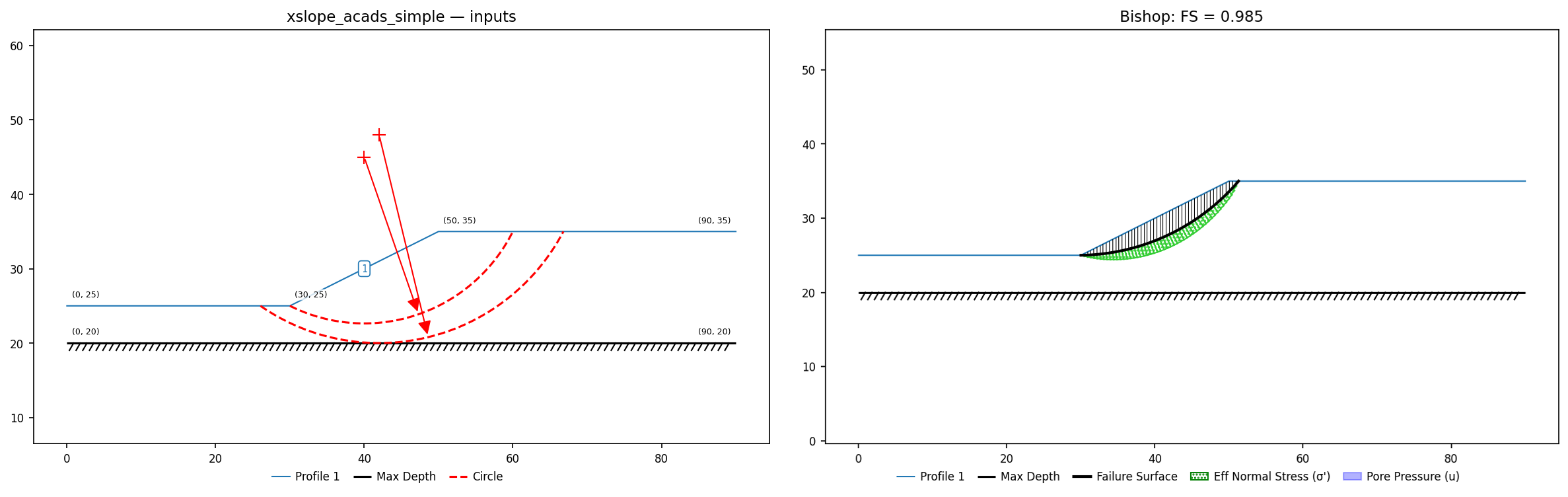
The headline ACADS limit-equilibrium benchmark: a simple homogeneous 2:1 slope analyzed with a circular search, with an accepted consensus FOS ≈ 1.00. It shares its XSLOPE input with the Rocscience corpus, so full geometry and material inputs are deferred to the linked VP1 detail.
Input: xslope_acads_simple.xlsx · Rocscience detail: VP1
| Method | XSLOPE | SLOPE/W | Reference |
|---|---|---|---|
| Bishop | 0.985 | 0.963 | Slide 0.987; ACADS 1.00 |
XSLOPE's Bishop FOS (0.985) matches Slide (0.987) and sits close to the ACADS consensus of 1.00, and reads slightly above SLOPE/W (0.963).
Sources: GeoStudio SLOPE/W Verification Manual §2.1; Donald & Giam (1989), Giam & Donald (1992).
2.2 — ACADS Tension Crack
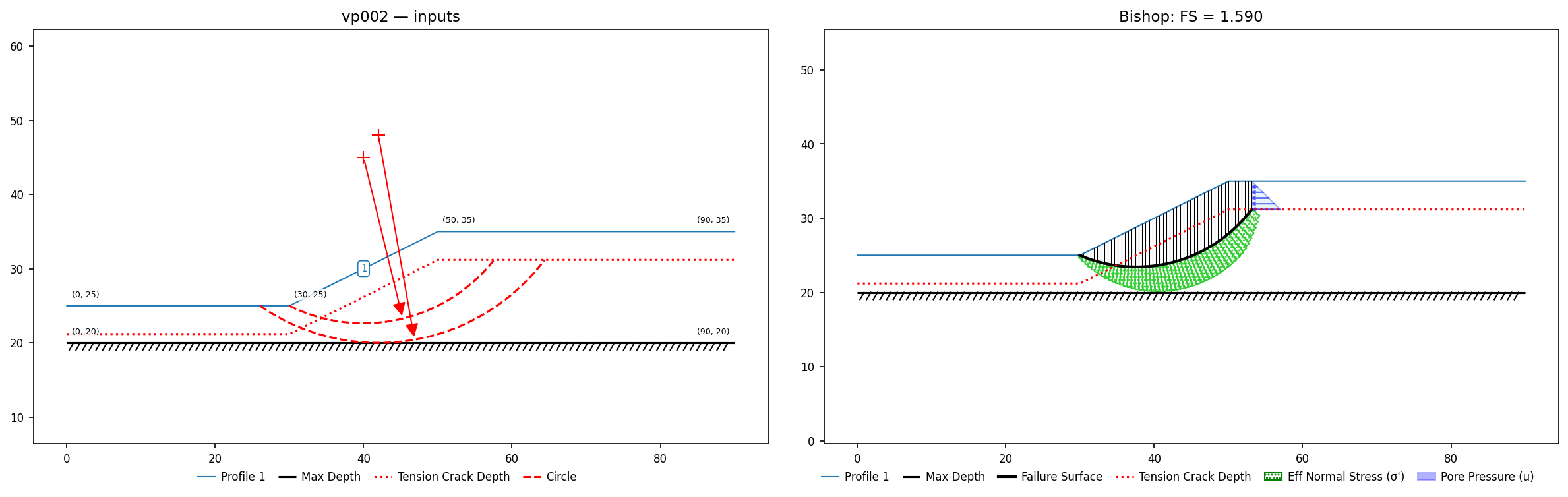
ACADS problem 1(b): a homogeneous slope with a water-filled tension crack, verifying tension-crack handling in the limit-equilibrium solution. It shares the vp002.xlsx XSLOPE input with the Rocscience corpus, so full geometry and material inputs are deferred to the linked Rocscience detail.
Input: vp002.xlsx · Rocscience detail: VP2
| Method | XSLOPE | SLOPE/W | Reference |
|---|---|---|---|
| Bishop | 1.589 | 1.664 | Slide 1.596 |
| Morgenstern-Price | 1.586 | 1.660 | Slide 1.592 |
SLOPE/W sits closer to the ACADS reference band (1.65–1.70) than XSLOPE or Slide2; the difference traces to tension-crack water handling and search.
Sources: GeoStudio SLOPE/W Verification Manual §2.2; Giam & Donald (1989).
2.3 — ACADS Non-Homogeneous
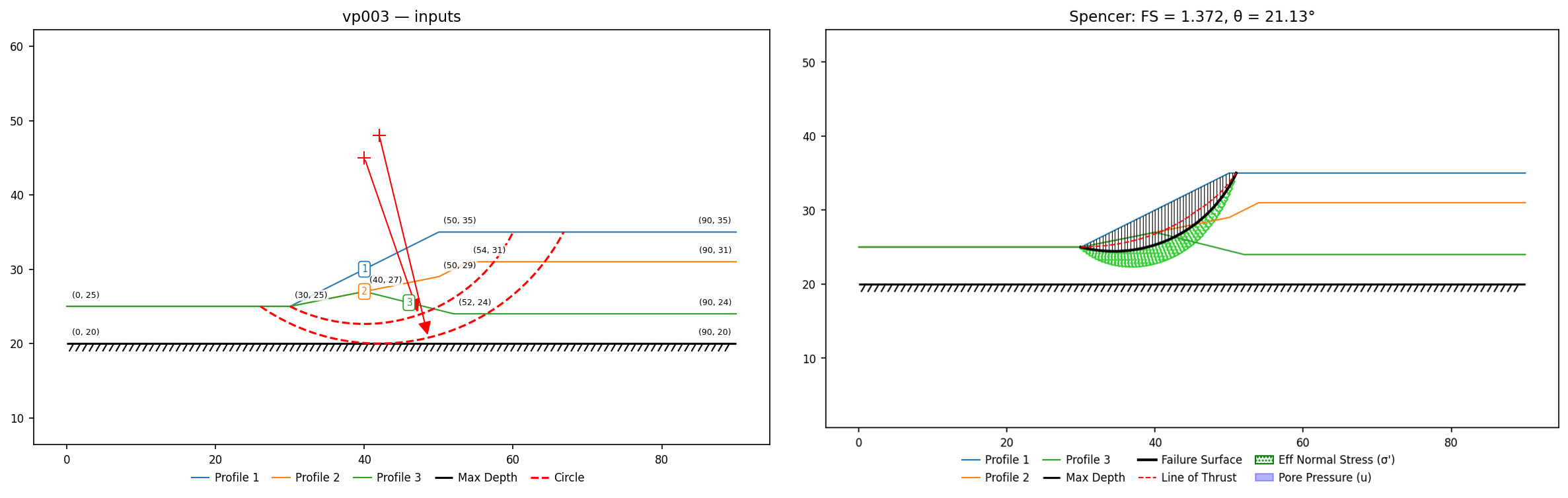
ACADS benchmark 1(c): a non-homogeneous three-layer slope analyzed for its critical circular surface. It shares the XSLOPE input (vp003.xlsx) with the Rocscience corpus, so the full geometry and material inputs are deferred to the linked Rocscience detail.
Input: vp003.xlsx · Rocscience detail: VP3
| Method | XSLOPE | SLOPE/W | Reference |
|---|---|---|---|
| Bishop | 1.403 | 1.414 | 1.39 (ACADS) |
| Morgenstern-Price | 1.371 | 1.382 | 1.39 (ACADS) |
XSLOPE agrees with SLOPE/W to within about 1% for both methods and brackets the ACADS consensus reference of 1.39.
Sources: GeoStudio SLOPE/W Verification Manual §2.3; Donald, I.B. & Giam, P. (1989), ACADS.
2.4 — ACADS Non-Homogeneous + Seismic
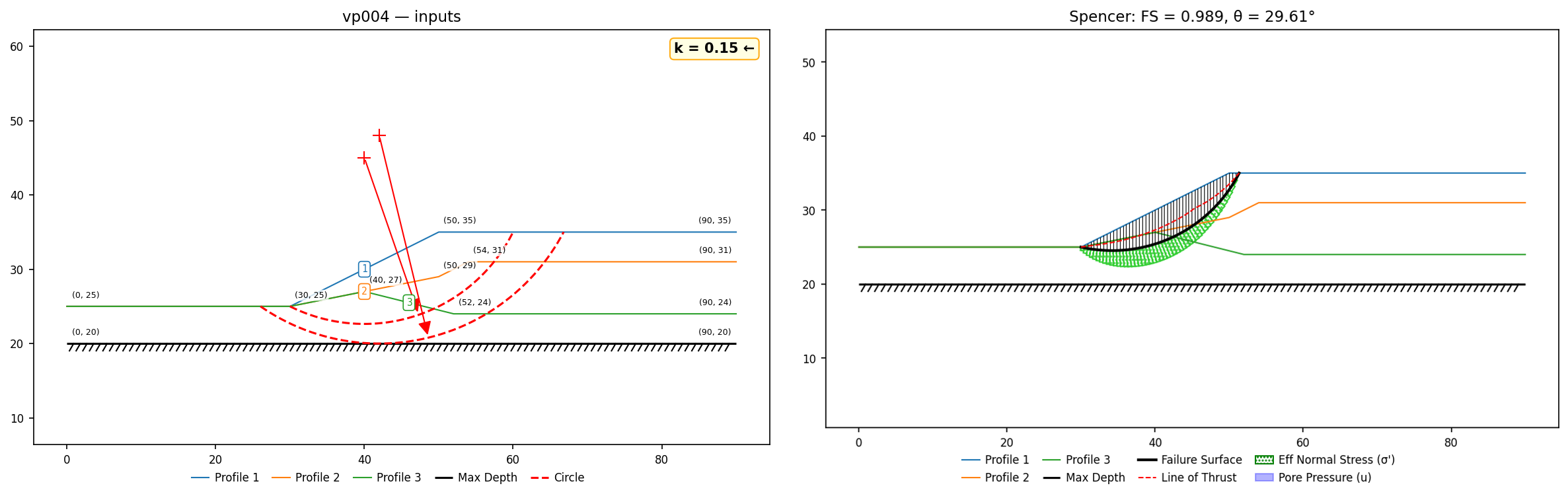
ACADS 1(d): the three-material non-homogeneous slope of §2.3 with a horizontal pseudo-static seismic coefficient of 0.15 added, verifying seismic loading over layered strengths. It shares the XSLOPE input vp004.xlsx with the Rocscience corpus, so the full geometry, material properties, and slip surface are documented in the linked Rocscience detail.
Input: vp004.xlsx · Rocscience detail: VP4
| Method | XSLOPE | SLOPE/W | Reference |
|---|---|---|---|
| Bishop | 1.013 | 1.02 | 1.00 |
| Morgenstern-Price | 0.987 | 0.989 | 1.00 |
XSLOPE's Bishop (1.013) and Morgenstern-Price (0.987) bracket the ACADS consensus of 1.00 and agree with SLOPE/W to within ~1%.
Sources: GeoStudio SLOPE/W Verification Manual §2.4; Donald, I.B. & Giam, P. (1989), ACADS suite.
2.5 — ACADS Talbingo Dam – Dry
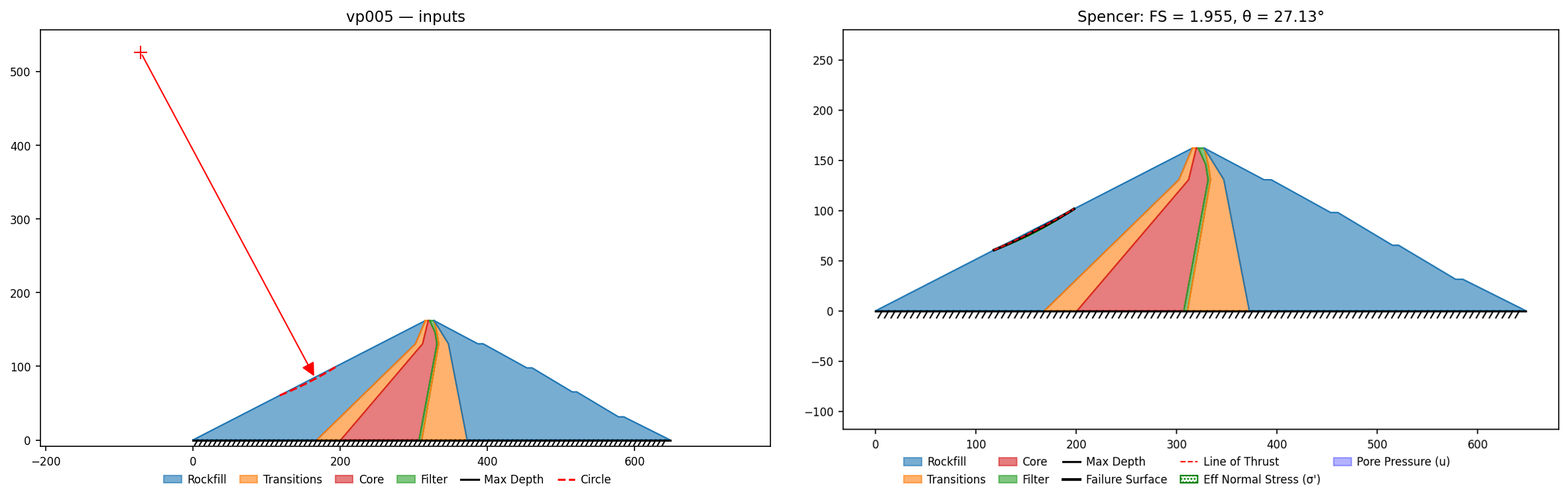
ACADS benchmark 2(a): the four-zone Talbingo Dam at end of construction (dry), searched for the critical circular surface, whose minimum collapses to a shallow infinite-slope mechanism parallel to the steeper upstream face. It shares the XSLOPE input vp005.xlsx with the Rocscience corpus, so the full geometry, zone properties, and per-method breakdown are deferred to the linked Rocscience detail.
Input: vp005.xlsx · Rocscience detail: VP5
| Method | XSLOPE | SLOPE/W | Reference |
|---|---|---|---|
| All methods (infinite-slope mechanism) | 1.955 | 1.951 | — |
Because the critical mechanism is the infinite-slope limit, every method converges to the same XSLOPE factor of safety of 1.955, in close agreement with SLOPE/W's 1.951.
Sources: GeoStudio SLOPE/W Verification Manual §2.5; Giam & Donald (1989), ACADS benchmark 2(a).
2.6 — ACADS Talbingo – Specified Surface
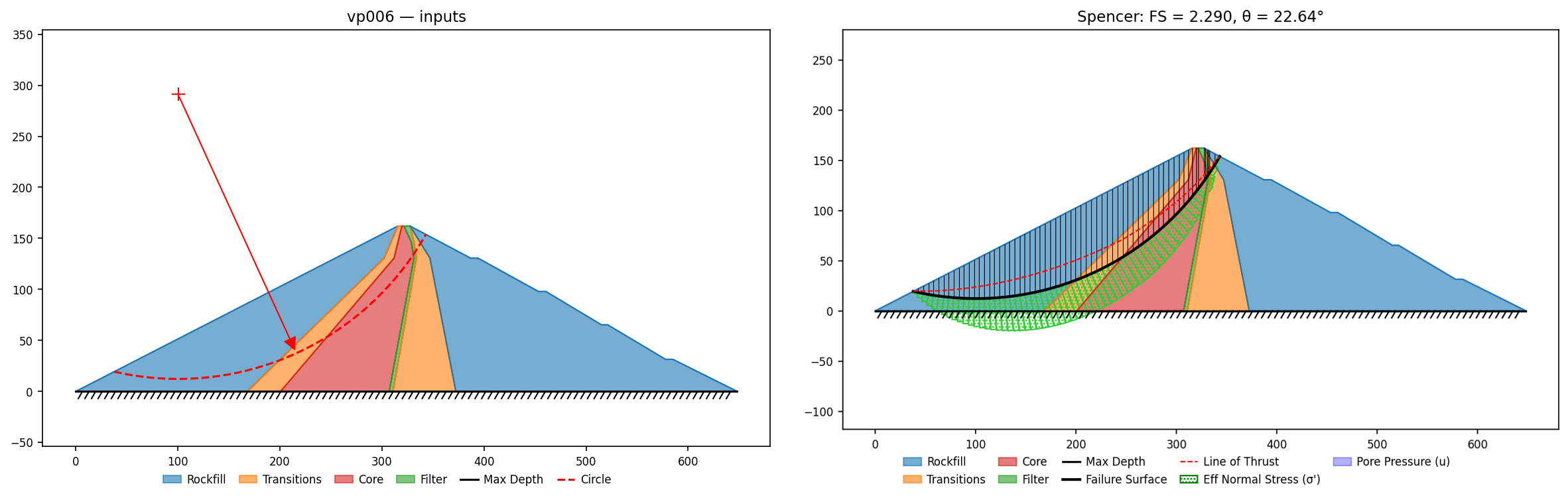
ACADS benchmark 2(b): the Talbingo Dam, a four-material embankment evaluated on a single specified circular slip surface, verifying that XSLOPE and SLOPE/W agree on a fixed surface. It shares the XSLOPE input vp006.xlsx with the Rocscience corpus, so the full geometry and material inputs are deferred to the linked VP6 detail.
Input: vp006.xlsx · Rocscience detail: VP6
| Method | XSLOPE | SLOPE/W | Reference |
|---|---|---|---|
| Bishop | 2.206 | 2.207 | — |
| Morgenstern-Price | 2.299 | 2.299 | — |
XSLOPE and SLOPE/W match essentially exactly: Bishop 2.206 vs 2.207 and Morgenstern-Price 2.299 vs 2.299.
Sources: GeoStudio SLOPE/W Verification Manual §2.6; ACADS benchmark (Giam & Donald).
2.7 — ACADS Weak Layer (non-circular)
The ACADS weak-layer case (SLOPE/W Verification Manual sec. 2.7): a 2:1 slope crossed by a thin low-strength interlayer with a piezometric line at its base. The critical surface is non-circular, sliding along the weak layer with a back scarp to the crest — this is the non-circular search verification test. The ACADS accepted band is FOS ≈ 1.26.
| Property | Soil 1 | Weak layer |
|---|---|---|
| Cohesion, \(c'\) (kPa) | 28.5 | 0 |
| Friction angle, \(\phi'\) | 20° | 10° |
| Unit weight, \(\gamma\) (kN/m³) | 18.84 | 18.84 |
Excel input file: xslope_acads_weak_layer.xlsx
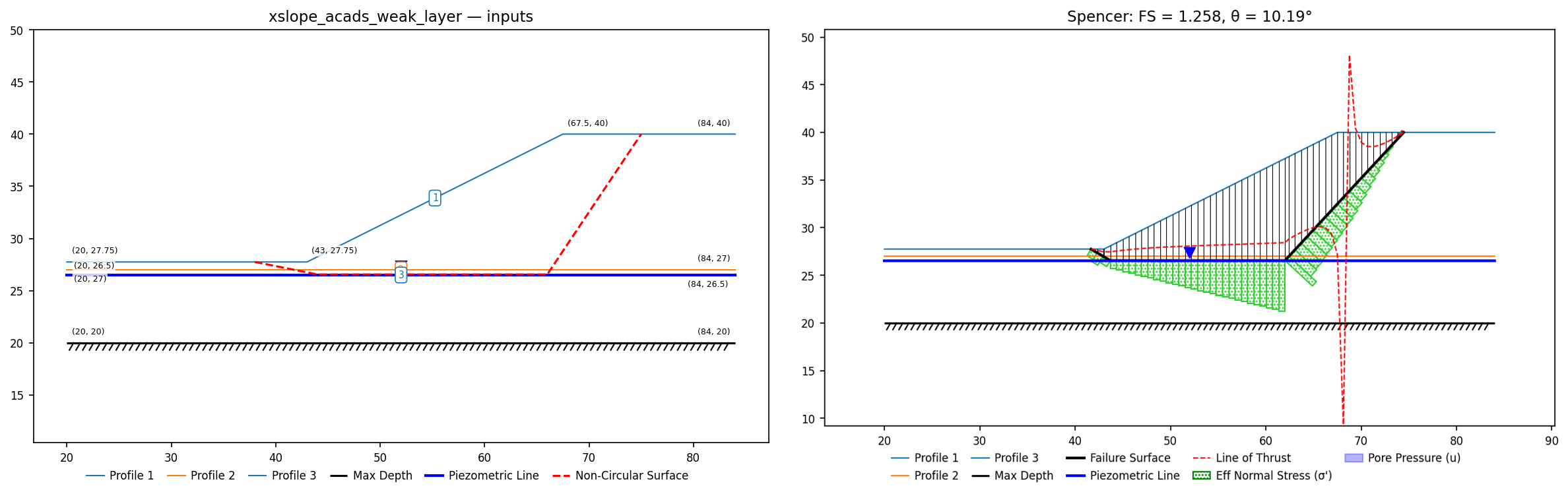
Results for the methods applicable to non-circular surfaces:
| Method | XSLOPE FOS | Reference | Diff |
|---|---|---|---|
| Spencer | 1.258 | ~1.26 | −0.2% |
| Morgenstern-Price | 1.248 | ~1.26 | −1.0% |
| Corps of Engineers | 1.336 | ~1.26 | +6.0% |
| Lowe & Karafiath | 1.249 | ~1.26 | −0.9% |
| Simplified Janbu | 1.278 | ~1.26 | +1.4% |
The two interior surface points are seeded just above the base of the weak
layer (base \(y=26.5\), top \(y=27.0\)). Because the non-circular search moves
Horiz points horizontally only, that seed elevation is the sliding plane:
placing it near the base of a weak interlayer is standard practice and matches
the reference, whereas seeding it at the layer center biases the factor of
safety roughly 1.5% high. With the base placement, XSLOPE's complete-equilibrium
methods land within ~1% of SLOPE/W's Morgenstern-Price value (1.261): Spencer at
1.258 (−0.2%) and Morgenstern-Price (half-sine) at 1.248 (−1.0%). Corps of
Engineers reads modestly
high here, consistent with ground-parallel side-force inclinations on a surface
with a steep back scarp (XSLOPE uses the standard "Corps #2" convention — see
Force Equilibrium Methods).
Sources: GeoStudio SLOPE/W Verification Manual, sec. 2.7; Donald, I.B. & Giam, P. (1989), ACADS.
Factor of safety by method (each method's own critical surface):
| OMS | Bishop | Janbu | Corps | Lowe | Spencer | M-P |
|---|---|---|---|---|---|---|
| — | — | 1.278 | 1.336 | 1.249 | 1.258 | 1.248 |
2.8 — ACADS Weak Layer – Specified Surface
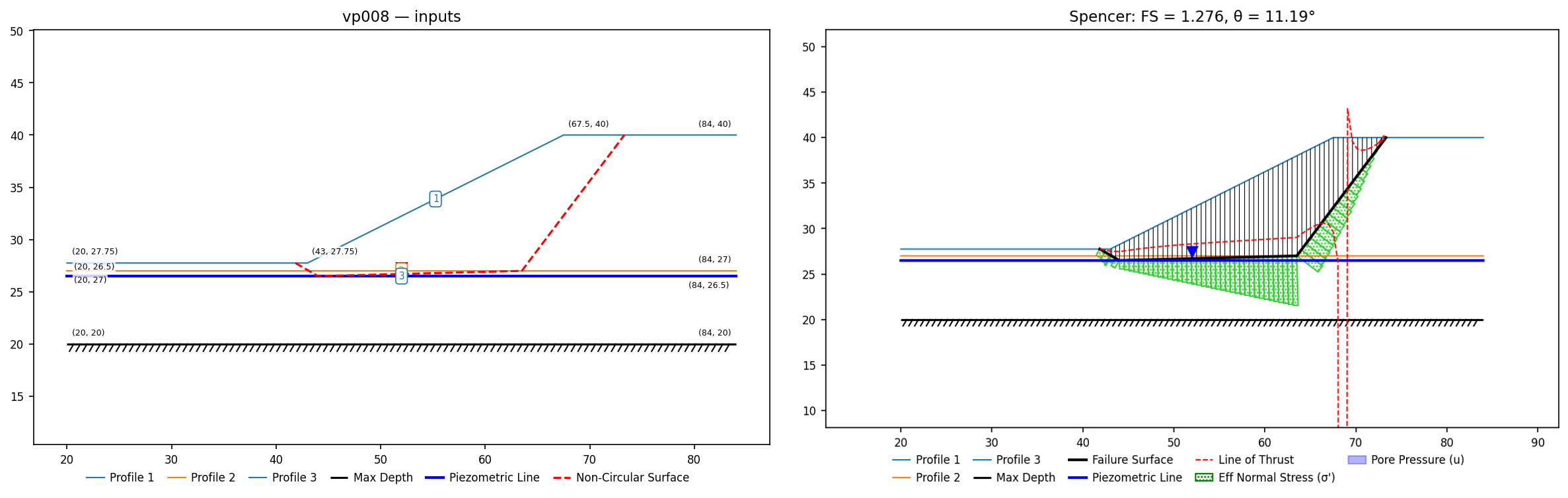
The ACADS 3(b) weak-layer slope analyzed on a fully specified non-circular slip surface, verifying XSLOPE against SLOPE/W for a two-material section with a thin weak seam. It shares its XSLOPE input (vp008.xlsx) with the Rocscience corpus, so the full geometry and material inputs are deferred to the linked Rocscience detail.
Input: vp008.xlsx · Rocscience detail: VP8
| Method | XSLOPE | SLOPE/W | Reference |
|---|---|---|---|
| Morgenstern-Price | 1.260 | 1.261 | — |
| Janbu (corrected) | 1.294 | 1.197 (force, ×fo ≈ 1.29) | — |
XSLOPE's Morgenstern-Price matches SLOPE/W's M-P essentially exactly (1.260 vs 1.261); XSLOPE's corrected Janbu (1.294) reproduces SLOPE/W's uncorrected force solution (1.197) once the Janbu fo correction (×fo ≈ 1.29) is applied.
Sources: GeoStudio SLOPE/W Verification Manual §2.8; Donald, I.B. & Giam, P. (1989), Soil slope stability programs review, ACADS, Melbourne.
2.9 — ACADS External Loading
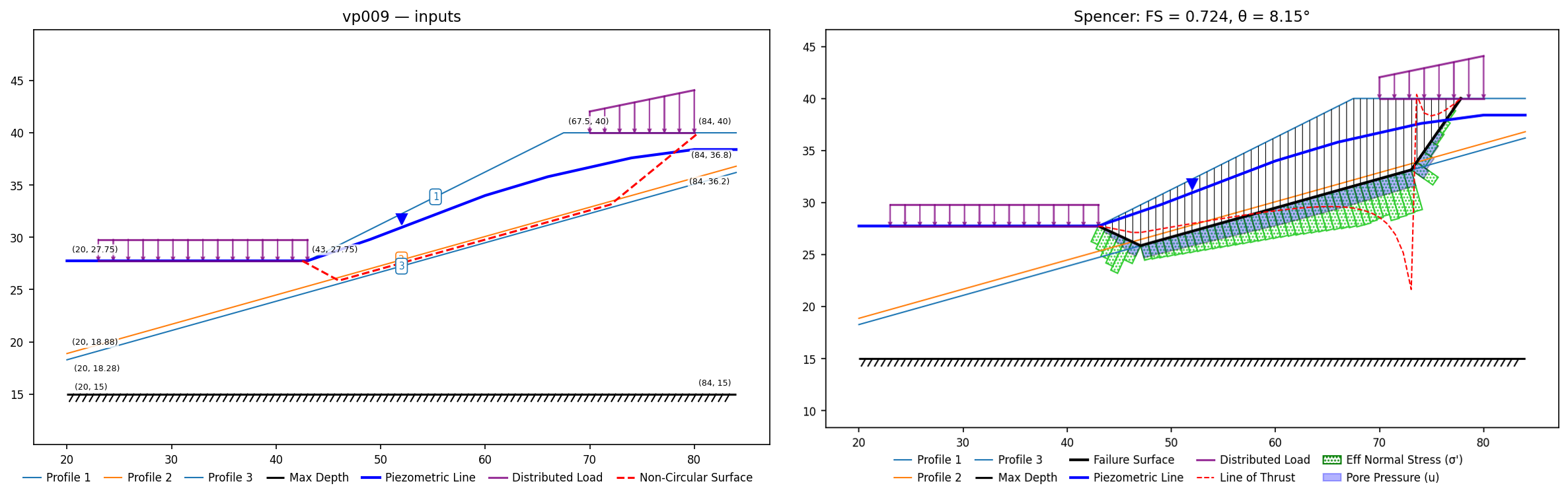
The ACADS benchmark (Slide #9): a two-material slope with a weak layer, a piezometric water table, and two surcharge strips, solved with a non-circular search. It shares the XSLOPE input vp009.xlsx with the Rocscience corpus, so the full geometry and inputs are deferred to the linked Rocscience detail.
Input: vp009.xlsx · Rocscience detail: VP9
| Method | XSLOPE | SLOPE/W | Reference |
|---|---|---|---|
| Spencer | 0.724 | — | — |
| Janbu (corrected) | 0.718 | — | — |
| Bishop | — | 0.699 | — |
| Morgenstern-Price | — | 0.689 | — |
This is a search-sensitive benchmark with a wide published spread (roughly 0.67–0.81); XSLOPE's Spencer (0.724) and corrected Janbu (0.718) sit just above the SLOPE/W Bishop (0.699) and Morgenstern-Price (0.689) values, with all four results falling inside the published band.
Sources: GeoStudio SLOPE/W Verification Manual §2.9; ACADS benchmark study (Giam & Donald).
2.11 — Arai & Tagyo Homogeneous
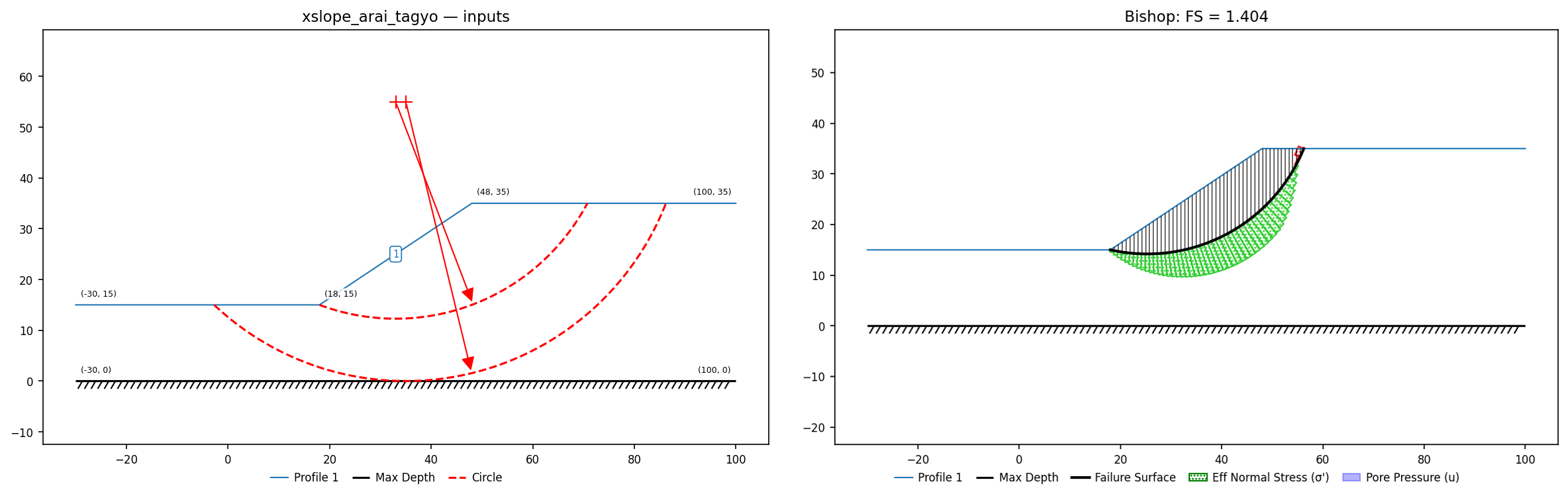
A homogeneous 20 m, 1.5:1 slope in total-stress soil (Arai & Tagyo 1985, example 1), used to verify the automated critical-circle search against SLOPE/W and the published reference. It shares the XSLOPE input file with the Rocscience corpus, so the full geometry and material inputs are deferred to the linked VP14 detail.
Input: xslope_arai_tagyo.xlsx · Rocscience detail: VP14
| Method | XSLOPE | SLOPE/W | Reference |
|---|---|---|---|
| Bishop's Simplified | see VP14 | 1.417 | 1.451 |
| Morgenstern-Price | see VP14 | 1.414 | 1.451 |
SLOPE/W's Bishop (1.417) and Morgenstern-Price (1.414) agree closely and both sit modestly below the Arai & Tagyo reference of 1.451; XSLOPE's full six-method results for this shared input are tabulated in the linked Rocscience detail.
Sources: GeoStudio SLOPE/W Verification Manual §2.11; Arai & Tagyo (1985).
2.12 — Arai & Tagyo Pore-Water Pressure
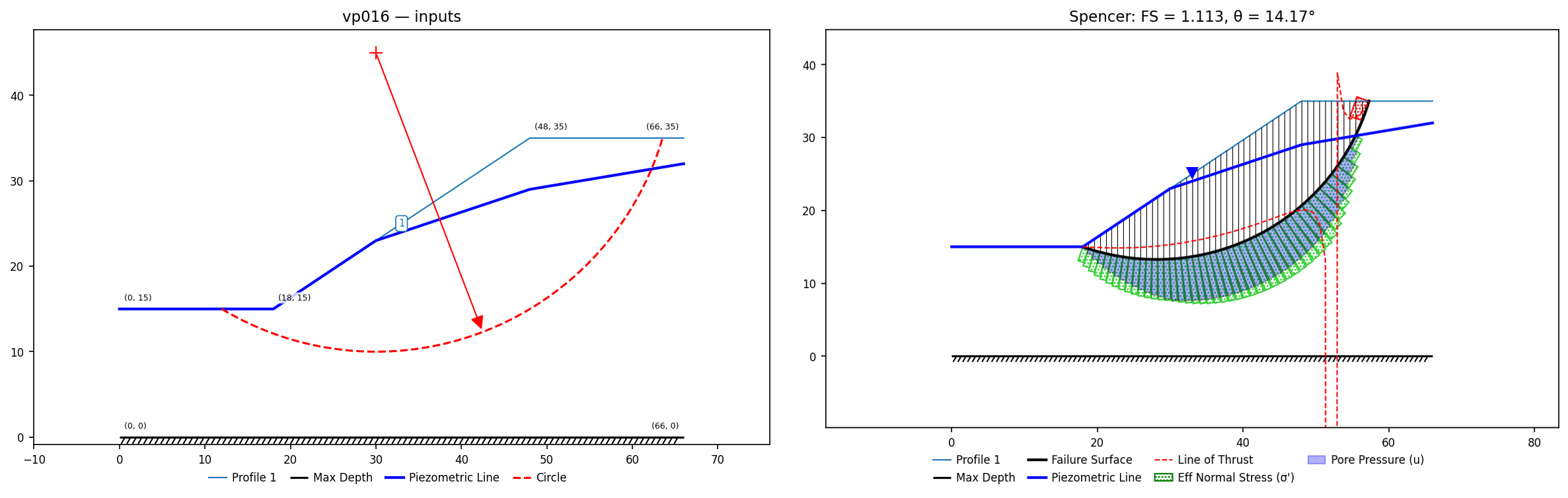
Arai & Tagyo (1985) example 3: a homogeneous slope with a water table, verifying pore-water pressure handling on a circular search. It shares the XSLOPE input vp016.xlsx with the Rocscience corpus, so the full geometry and inputs are given in the linked Rocscience detail.
Input: vp016.xlsx · Rocscience detail: VP16
| Method | XSLOPE | SLOPE/W | Reference |
|---|---|---|---|
| Bishop | 1.112 | 1.190 | Slide 1.118; A&T 1.138 |
XSLOPE's Bishop 1.112 agrees closely with Slide 1.118 and the Arai & Tagyo reference 1.138; SLOPE/W's 1.190 is the outlier of the four sources.
Sources: GeoStudio SLOPE/W Verification Manual §2.12; Arai & Tagyo (1985).
2.13 — Greco Layered Slope
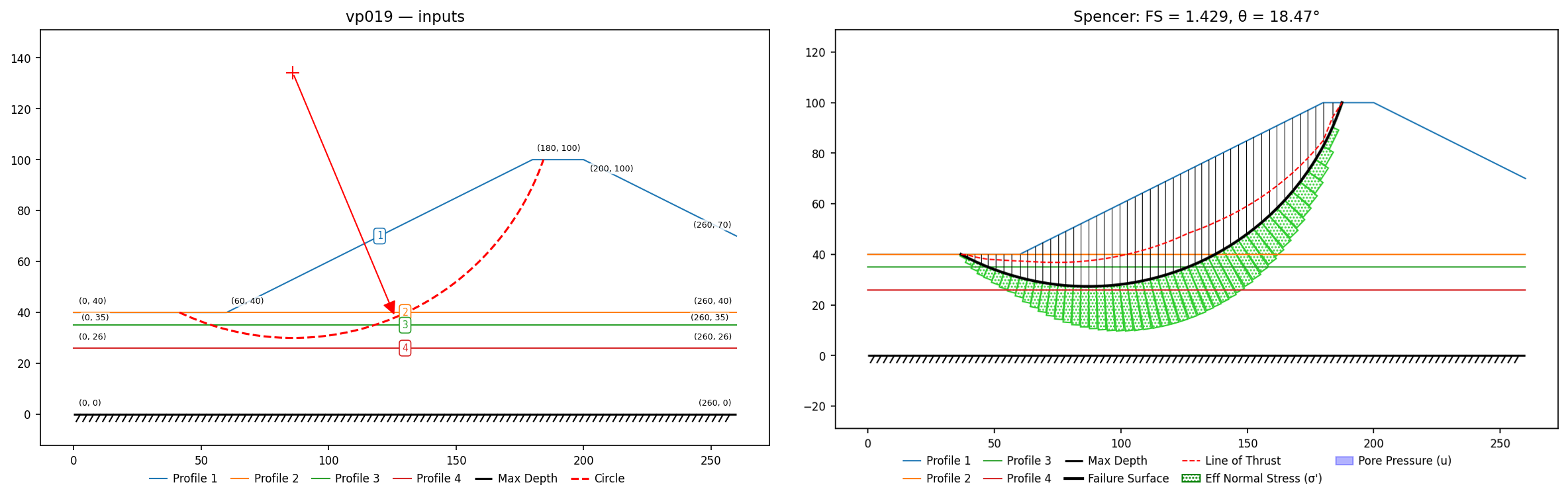
A four-layer slope with no water (Greco 1996, example 4 / Yamagami & Ueta 1988), verifying the critical-surface search against a shallow non-circular benchmark optimum. It shares the vp019.xlsx XSLOPE input with the Rocscience corpus, so full geometry and material inputs are deferred to the linked Rocscience detail.
Input: vp019.xlsx · Rocscience detail: VP19
| Method | XSLOPE | SLOPE/W | Reference |
|---|---|---|---|
| Spencer / M-P | 1.429 | 1.389 | Greco 1.40–1.42 |
XSLOPE's circular Spencer (1.429) agrees with SLOPE/W's Morgenstern–Price solution (1.389) and brackets the Greco reference range (1.40–1.42).
Sources: GeoStudio SLOPE/W Verification Manual §2.13; Greco (1996), Yamagami & Ueta (1988).
2.14 — Greco Weak Layer
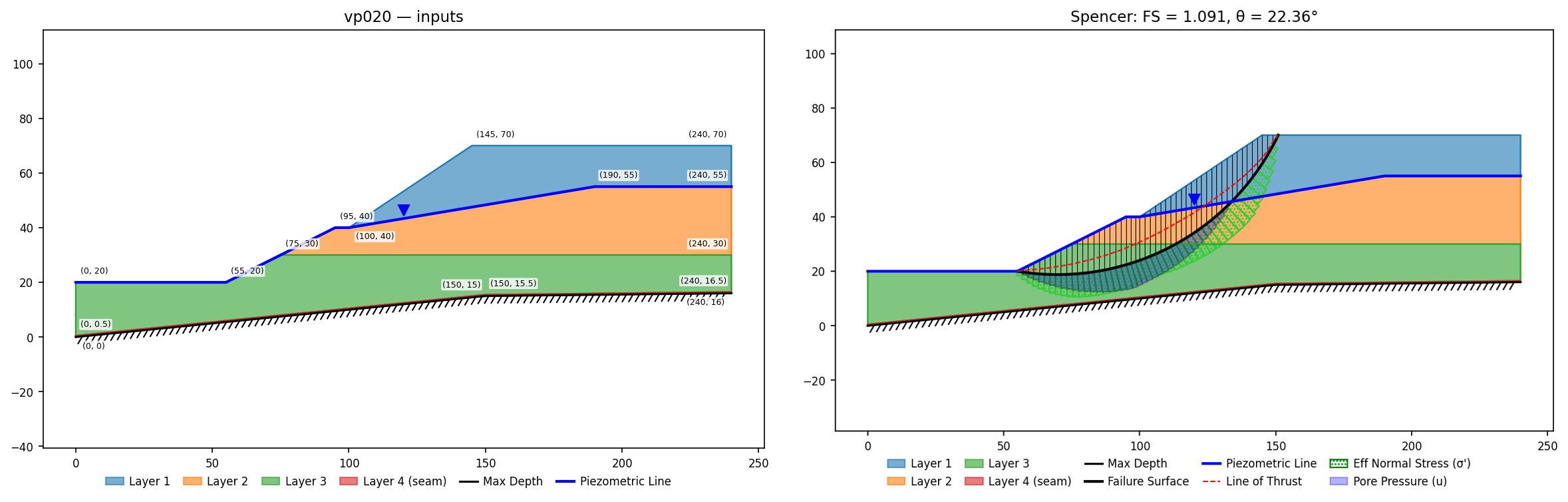
A four-layer slope with a 0.5 m weak seam running along the inclined model base beneath a water table, verifying the search for a noncircular slip surface through a weak layer. It shares the XSLOPE input vp020.xlsx with the Rocscience corpus, so full geometry and inputs are deferred to the linked Rocscience detail.
Input: vp020.xlsx · Rocscience detail: VP20
| Method | XSLOPE | SLOPE/W | Reference |
|---|---|---|---|
| Spencer (noncircular) | 1.082 | 1.054 | Greco 1.08 |
| Spencer (circular) | 1.091 | — | — |
XSLOPE's noncircular Spencer solution (1.082) matches the published Greco value (1.08) and runs slightly above SLOPE/W's Spencer result (1.054); the circular Spencer surface gives a marginally higher 1.091.
Sources: GeoStudio SLOPE/W Verification Manual §2.14; Greco (1996) ex. 5; Chen & Shao (1988).
2.15 — Chen & Shao Frictionless Slope
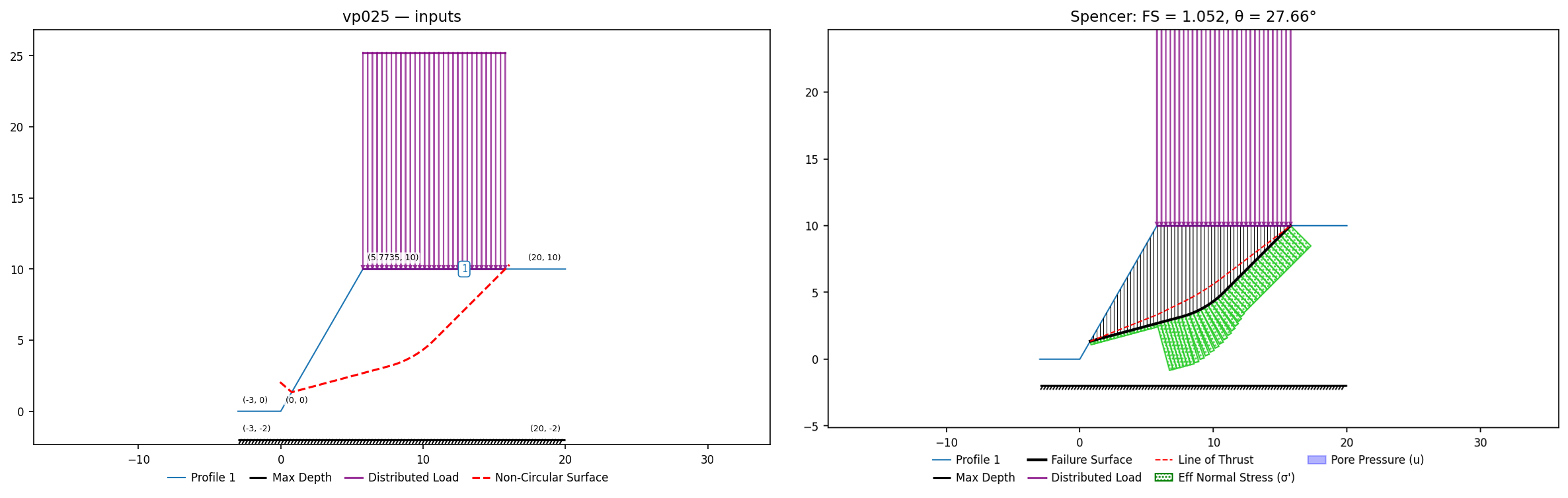
The classical Prandtl bearing mechanism on a weightless, frictionless 60° slope under a critical strip load, verifying limit-equilibrium against the theoretical FS = 1.0. This is the same problem as the Rocscience corpus, sharing XSLOPE input vp025.xlsx; see the linked Rocscience detail for the full geometry, materials, and analytically constructed slip surface.
Input: vp025.xlsx · Rocscience detail: VP25
| Method | XSLOPE | SLOPE/W | Reference |
|---|---|---|---|
| Spencer | 1.052 | 1.036 | Slide 1.051; theory 1.0 |
XSLOPE's Spencer FS of 1.052 matches Slide (1.051) and sits just above SLOPE/W (1.036), all close to the theoretical value of 1.0 for this frictionless mechanism.
Sources: GeoStudio SLOPE/W Verification Manual §2.15; Chen & Shao (1988).
2.16 — Prandtl Bearing Capacity
The classical Prandtl bearing mechanism on level ground: a weightless (γ ≈ 0), c = 20 kPa, φ = 0 soil under a strip surcharge of 102.83 kPa — exactly c·Nc, so the theoretical factor of safety is 1.0 by construction. Both ground crossings of the slip surface sit at the same elevation, which used to trip the flat-arc facing guard; the right_facing override built for this problem (Rocscience VP26) resolves that, so the surface — an active wedge, a log-spiral/circular fan, and a passive wedge — solves cleanly. This is the same problem as the Rocscience corpus, sharing XSLOPE input vp026.xlsx; see the linked Rocscience detail for the full geometry and slip-surface construction.
SLOPE/W's own file was also checked directly: its "Fully Specified" analysis solves the identical, non-circular Prandtl surface at FS = 0.960 (Morgenstern-Price) — read straight from the model's saved results via read_gsz_results. That number is quoted rather than reproduced, because the .gsz importer does not yet rebuild a fully-specified (non-circular) surface into an XSLOPE slip surface; that is a separate, narrower gap than the flat-arc guard, and unrelated to it.
Input: vp026.xlsx · Rocscience detail: VP26
| Method | XSLOPE | SLOPE/W | Reference |
|---|---|---|---|
| Spencer | 1.043 | 0.960* | theory 1.0; Slide2 0.941 |
* SLOPE/W's own Morgenstern-Price solve of its fully-specified surface, not an XSLOPE re-solve — see above.
XSLOPE's Spencer (1.043) and SLOPE/W's own Morgenstern-Price (0.960) bracket the theoretical FS of 1.0 from opposite sides, about 4% apart each way — the same interslice-convention spread already documented for VP26 against Slide2 (0.941), not a new discrepancy.
Sources: GeoStudio SLOPE/W Verification Manual §2.16; Prandtl (1921).
2.18 — Borges & Cardoso – Geosynthetic Embankment #2
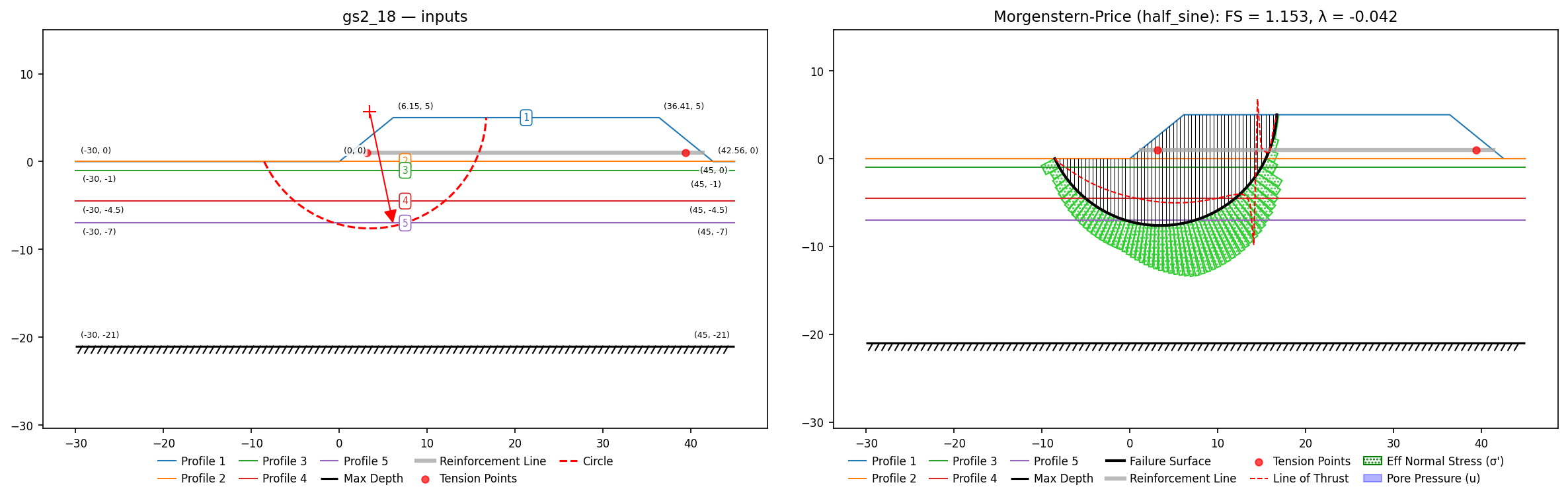
Borges & Cardoso (2002)'s Case 2: a 5 m geosynthetic-reinforced embankment (c′ = 0,
φ′ = 35°, γ = 20) over four soft-clay layers whose undrained strength increases with
depth. The two deeper clays are GeoStudio "Su-varies-with-depth" (SFnDepth) materials,
which map exactly onto XSLOPE's cp option (Su = c + cp·max(0, r_elev − y)): Clay 3 is
16 + 0.96·z and Clay 4 is 18.4 + 1.314·z below their layer tops (the mapped rates
reproduce the manual's printed layer-bottom strengths to the digit). The geosynthetic
(Tmax = 200 kN/m, interface friction 33.7°, unanchored) is laid at y = 1.0 across the
embankment base as an axial geosynthetic; on the critical surface it is fully embedded,
so the full 200 kN/m develops and the factor of safety is insensitive to the bond
length. This is also Slide2 VP31 (the same Borges & Cardoso Case 2,
materials matching to rounding), which is covered by this build; the full geometry
is in the builder (benchmarks/geostudio/build_gs2_18.py).
Input: gs2_18.xlsx
| Method | XSLOPE | SLOPE/W | Reference |
|---|---|---|---|
| Morgenstern-Price | 1.153 | 1.171 | Borges & Cardoso 1.15 |
| Bishop | 1.154 | 1.170 | — |
| Janbu | 1.327 | 1.233 | — |
Run on SLOPE/W's own critical circle (which a grid search confirms is also XSLOPE's critical), XSLOPE's Morgenstern-Price 1.153 sits 1.5% below SLOPE/W's 1.171 and 0.3% above the Borges & Cardoso (2002) published 1.15; Bishop tracks at −1.4%. Janbu is higher because XSLOPE reports the f₀-corrected value where the manual's Janbu column is uncorrected. Without the geosynthetic the M-P factor falls to 1.011, so the reinforcement carries a large share of the resistance.
Sources: GeoStudio SLOPE/W Verification Manual §2.18; Borges & Cardoso (2002).
2.23 — Li & Lumb – Reliability Index
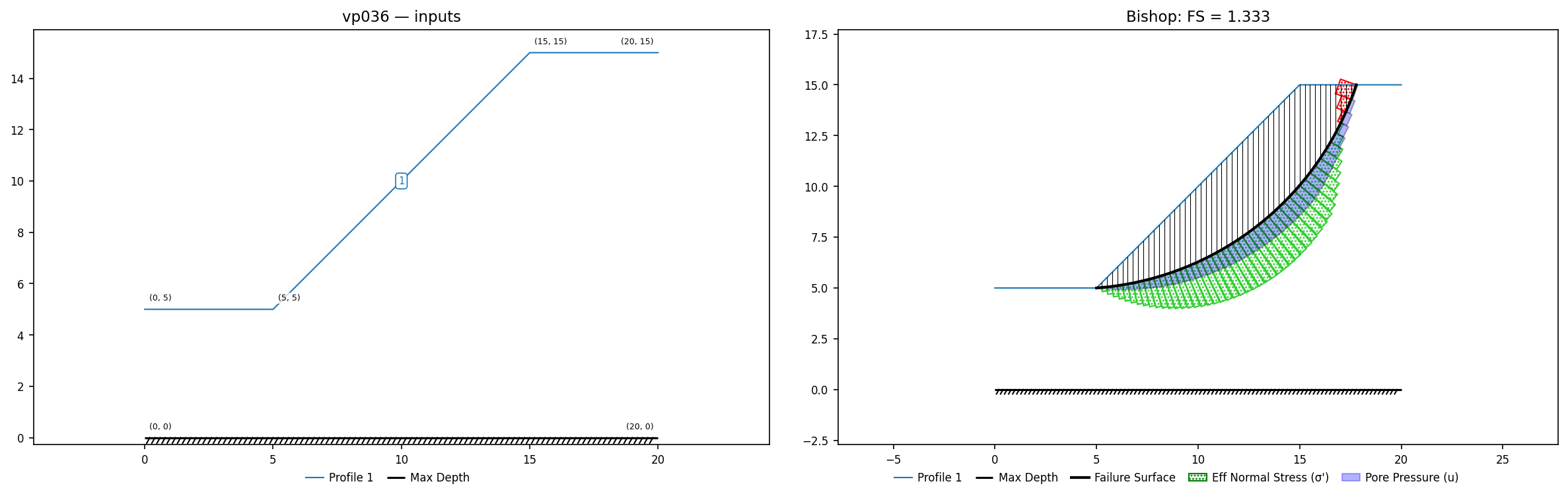
The Li & Lumb (1987) / Hassan & Wolff (1999) reliability benchmark: a homogeneous slope with an r_u pore-pressure ratio for which both the deterministic Bishop factor of safety and the lognormal reliability index β are computed from the variability in c′, φ′, and γ. It shares the vp036.xlsx input with the Rocscience corpus, so the full geometry and material statistics are deferred to the linked Rocscience detail.
Input: vp036.xlsx · Rocscience detail: VP36
| Method | XSLOPE | SLOPE/W | Reference |
|---|---|---|---|
| Bishop (deterministic FS) | 1.333 | 1.190 | 1.334 |
| Reliability index β_ln | 2.263 | 2.04 | 2.336 |
XSLOPE's deterministic Bishop FS (1.333) and its β on that surface (2.263) match the Hassan & Wolff reference (1.334 / 2.336); SLOPE/W instead searches for the minimum reliability index across surfaces, reporting β 2.04 at FS 1.190, so its β and FS are not evaluated on the deterministic surface.
Sources: GeoStudio SLOPE/W Verification Manual §2.23; Li & Lumb (1987), Hassan & Wolff (1999).
2.24 — Tandjiria – Geosynthetic Reinforced Emb.
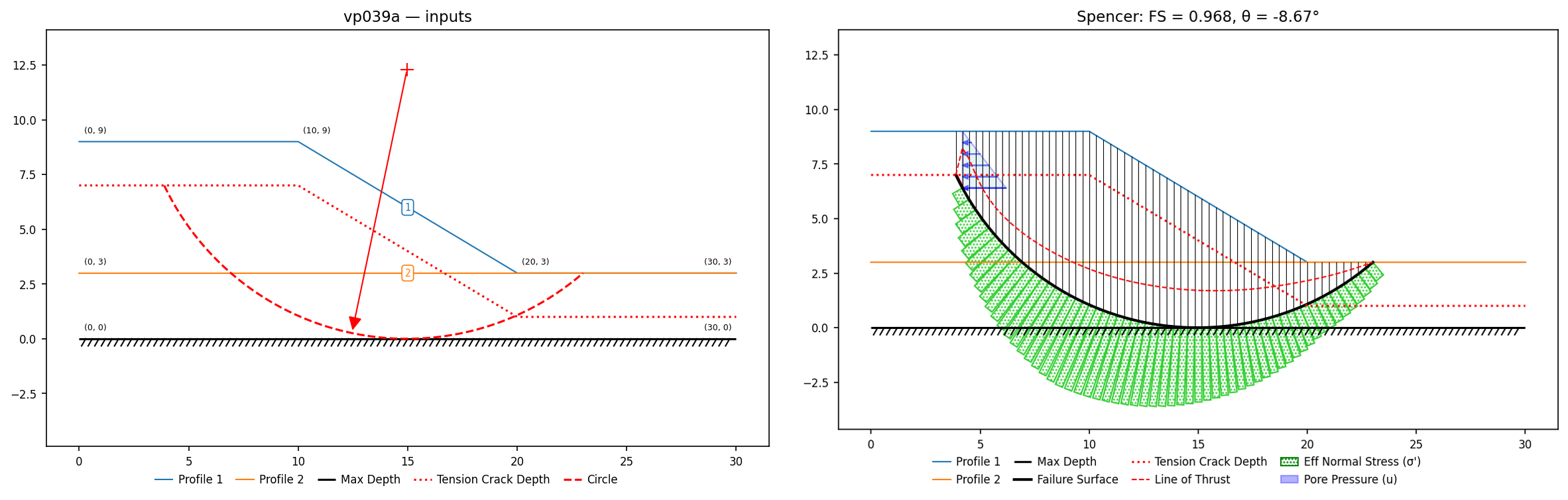
Tandjiria (2002)'s required-reinforcement half-embankment on soft clay, evaluated as a clay fill and as a sand fill with a geosynthetic at the embankment base. It shares the XSLOPE input (vp039a) with the Rocscience corpus, so the full geometry and inputs are deferred to the linked Rocscience detail; here the section's distinct role is as the geosynthetic-reinforcement benchmark for the SLOPE/W importer.
Input: vp039a.xlsx · Rocscience detail: VP39
| Method | XSLOPE | SLOPE/W | Reference |
|---|---|---|---|
| Clay fill, reinforced (imported, on SLOPE/W's own circles) | −0.27% | baseline | — |
| Sand fill, reinforced (imported, on SLOPE/W's own circles) | −0.64% | baseline | — |
Run on SLOPE/W's own critical circles, the imported geosynthetic reproduces SLOPE/W's reinforced factor of safety to within −0.27% (clay fill) and −0.64% (sand fill), isolating the reinforcement handling with no search difference to explain away.
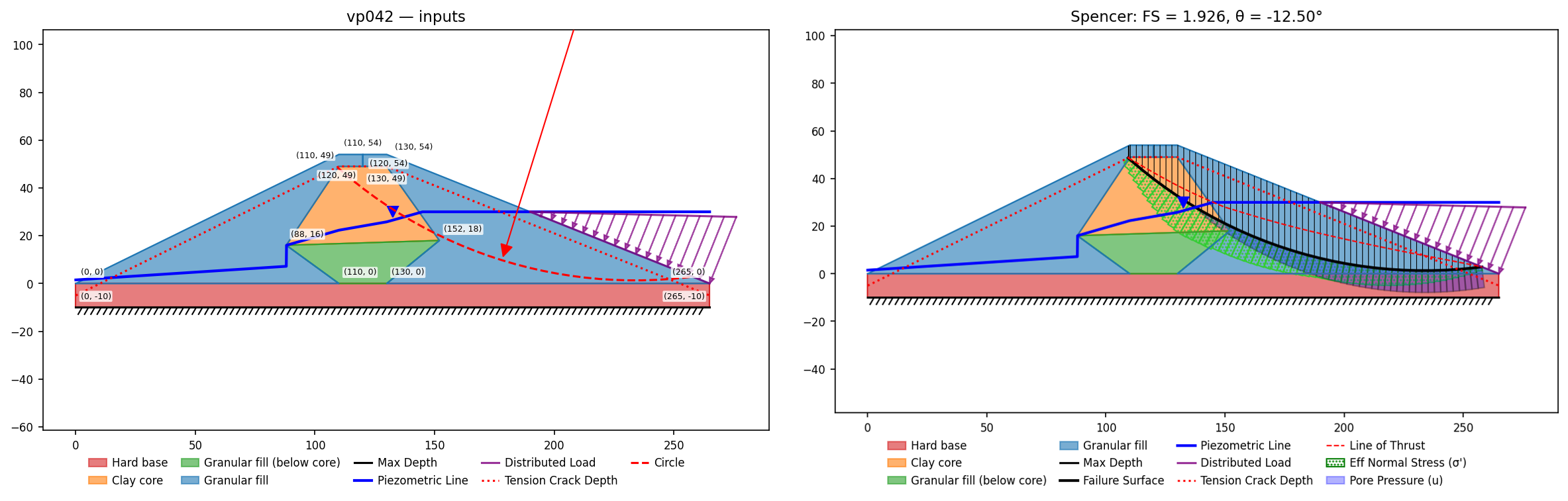
Sources: GeoStudio SLOPE/W Verification Manual §2.24; Tandjiria (2002).
2.25 — Baker & Leshchinsky – Earth Dam
Baker & Leshchinsky (2001)'s safety-map clay-core dam: granular fill (c′ = 0, φ′ = 40°,
γ = 21.5) around a diamond core (c′ = 20, φ′ = 20°, γ = 20) on a hard base (c′ = 200,
φ′ = 45°), a half-full upstream reservoir, a phreatic surface dropping through the core
to the downstream toe, and a 5-m cracked crest layer modeled as a dry tension crack. It
shares the vp042.xlsx XSLOPE input with the Rocscience corpus, so the full geometry and
inputs are deferred to the linked Rocscience detail — where this problem's
verification is documented in full. The XSLOPE input is tiled directly as the
material-zone polygons of this model's own .gsz region set.
Input: vp042.xlsx · Rocscience detail: VP42
| Method | XSLOPE (rigorous statics) | SLOPE/W (own solve) | Reference |
|---|---|---|---|
| Spencer, Slide's critical circle | 1.926 | — | Slide 1.925 |
| Spencer, SLOPE/W's own circle | 1.939 | 1.934 | — |
| Spencer, Baker's surface | 1.882 | — | Baker & Leshchinsky (2001) 1.91 |
XSLOPE reproduces the tightly clustered published references on all three surfaces. On
SLOPE/W's own solved critical circle (read from the .gsz) the two programs agree to
within 0.005 in Spencer FS on the identical surface, geometry, and water, with XSLOPE's
total sliding-mass weight ≈ 56,020 against SLOPE/W's 56,127. Both sides use total unit
weight + phreatic pore pressure (confirmed verbatim from B&L 2001 and by inspection of
this model's own materials); the reservoir-load statics are exact against a buoyant-weight
oracle, and XSLOPE's phreatic matches this model's own piezometric line to within ~0.2 m
along the failure surface. The XSLOPE values are regression-locked as VP42. The B&L (2001)
paper — held in the reference library — supplies the phreatic geometry the vendor manuals
leave unlabeled (its Fig. 5(a)) and reports the dam's global minimum Fmin = 1.91 by
Spencer's method, computed with total unit weight and pore pressure taken from the vertical
distance to the phreatic surface.
Sources: GeoStudio SLOPE/W Verification Manual §2.25; Baker & Leshchinsky (2001).
2.26 — Baker – Planar Homogeneous
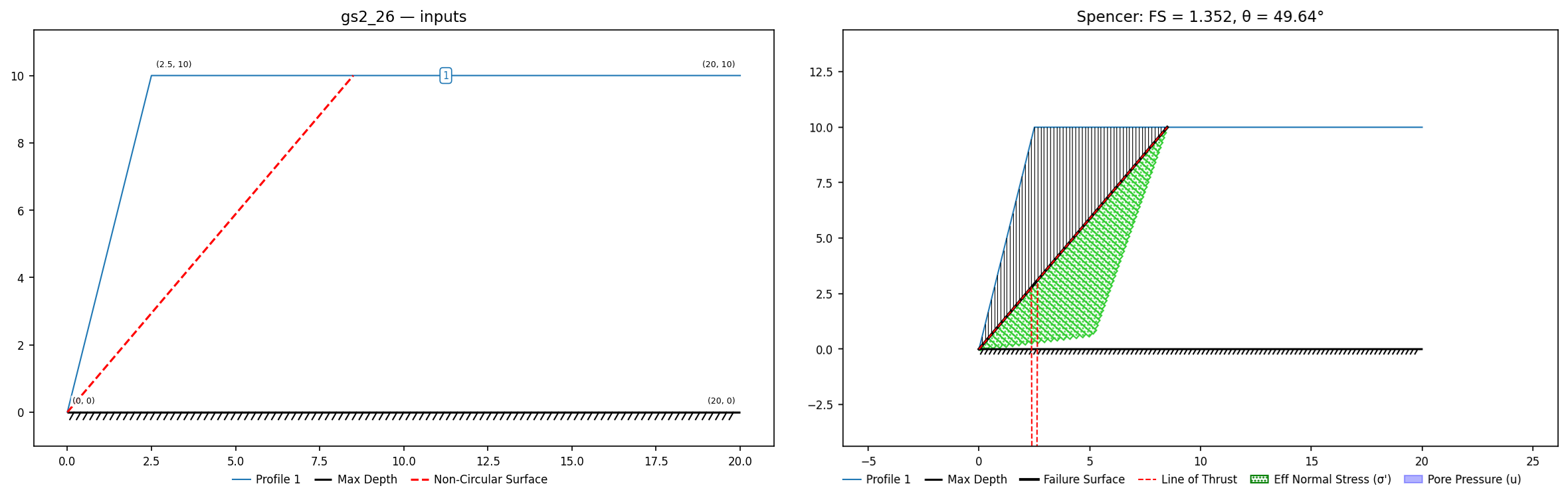
Baker (2001)'s planar-slip-surface benchmark: a homogeneous, dry c′-φ′ slope (H = 10 m, face angle 76.0°, c′ = 30, φ′ = 30°, γ = 20) evaluated on planes through the toe, with FS plotted against the daylight point's normalized position X = x/H on the backslope. The critical plane sits at X = 0.85. The SLOPE/W model pins the exact geometry (crest offset 2.5 m) — which also resolves the Rocscience corpus's VP43 analog, whose build inferred 3 m and read FS ≈ 1.43 against the ≈ 1.35 references.
Input: gs2_26.xlsx
| Method | XSLOPE | SLOPE/W | Reference |
|---|---|---|---|
| Spencer / Janbu | 1.352 | 1.352 | Baker & Leshchinsky (2001) ≈ 1.35 |
XSLOPE's Spencer and Janbu match SLOPE/W's own solved value (1.352, on the identical toe-to-(8.5, 10) plane; sliding-mass weight 600 kN/m agrees exactly) to within 0.01%, and the Baker & Leshchinsky reference to 0.15%. XSLOPE's Morgenstern-Price declines this surface: on a single straight plane α is constant for every slice, and the unconstrained λ-search reaches equilibrium only by driving ~70% of the interslice forces into tension — the solver's admissibility guard rejects that as unphysical (Corps and Lowe-Karafiath hit the same guard), leaving Spencer as the rigorous method that converges.
Sources: GeoStudio SLOPE/W Verification Manual §2.26; Baker (2001); Baker & Leshchinsky (2001).
2.27 — Sheahan – Amherst Soil Nails
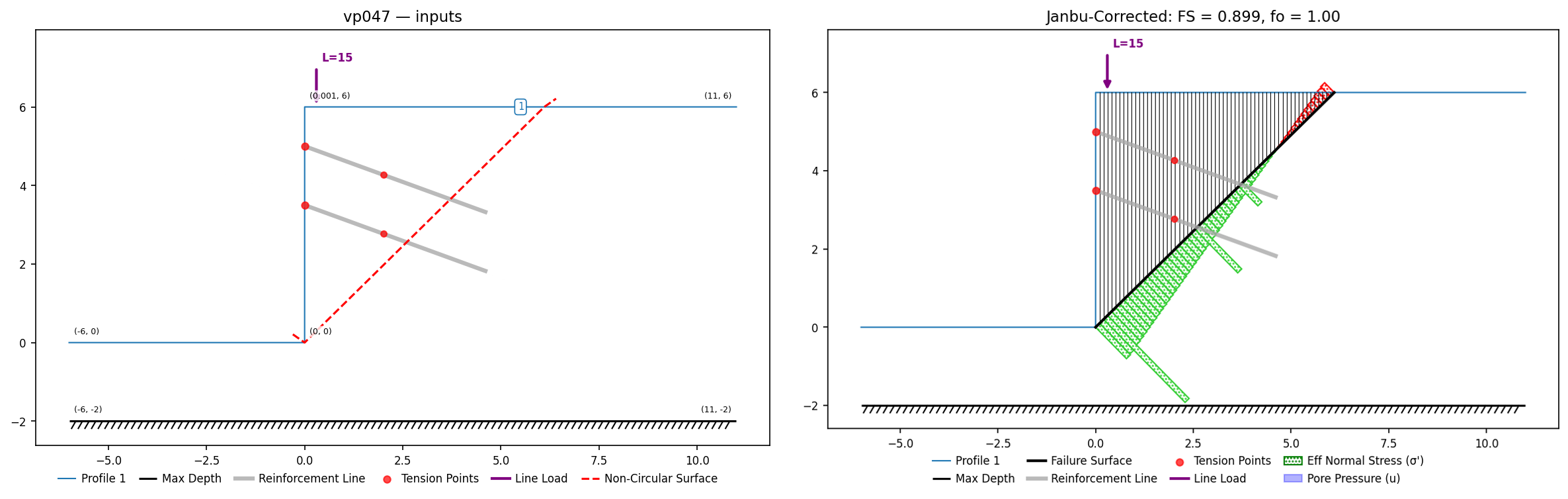
The Amherst test wall — a 6 m vertical cut in undrained clay retained by two rows of soil nails and a shotcrete facing, which failed in the field test — evaluated on planar surfaces through the toe. It reuses the same XSLOPE input as the Rocscience corpus, so the full geometry, nail capacities, and loading are deferred to the linked Rocscience detail.
Input: vp047.xlsx · Rocscience detail: VP47
| Method | XSLOPE | SLOPE/W | Reference |
|---|---|---|---|
| Janbu | 0.899 | — | Slide 0.890; Sheahan 0.887 |
XSLOPE's Janbu FS of 0.899 agrees closely with Slide's 0.890 and Sheahan's trial-wedge 0.887; the SLOPE/W model itself is a public download rather than a tabulated FS here.
Sources: GeoStudio SLOPE/W Verification Manual §2.27; Sheahan & Ho (2003).
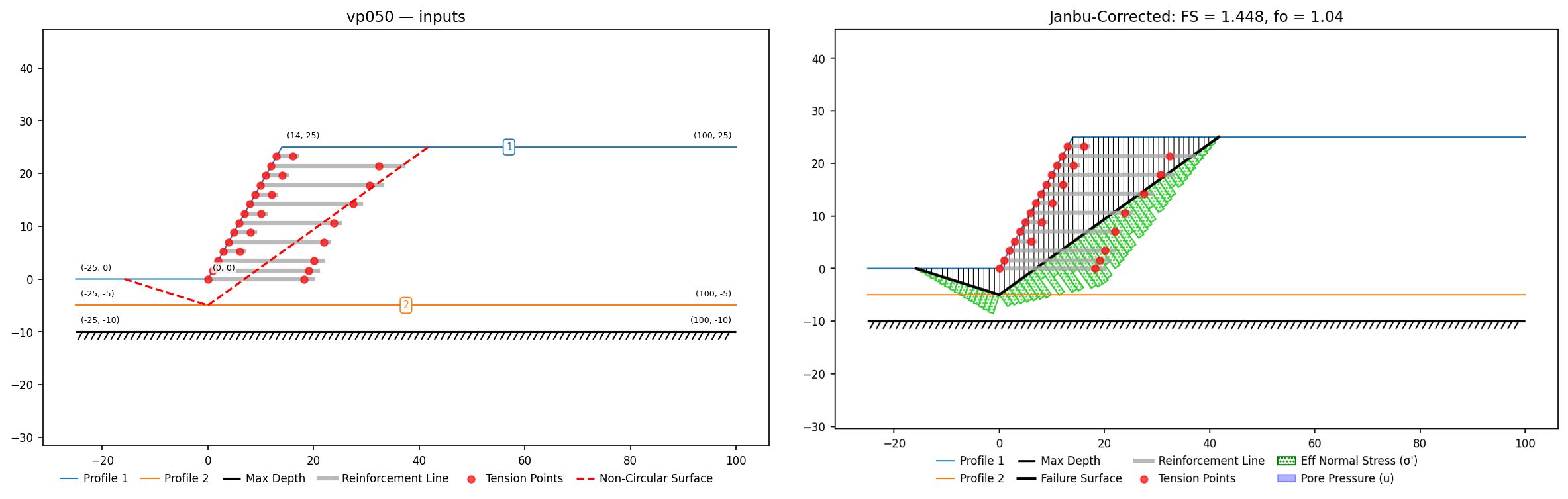
2.30 — Snailz – Geotextile Layers
A reinforced-slope problem from the Caltrans SNAILZ reference manual — a multi-row nail/geotextile-reinforced wall evaluated on a predefined deep wedge surface — verifying XSLOPE's reinforcement handling against SLOPE/W and the published SNAILZ solution. It shares the vp050.xlsx input with the Rocscience corpus, so full geometry and reinforcement inputs are deferred to the linked VP50 detail.
Input: vp050.xlsx · Rocscience detail: VP50
| Method | XSLOPE | SLOPE/W | Reference |
|---|---|---|---|
| Janbu (corrected) | 1.448 | 1.354 (force, ×fo ≈ 1.44) | SNAILZ 1.46 |
| Morgenstern-Price / Spencer | 1.576 | 1.606 (M-P) | — |
XSLOPE's Janbu (corrected) 1.448 matches SLOPE/W's uncorrected force solution 1.354 once the fo correction (×fo ≈ 1.44) is applied and agrees with the SNAILZ 1.46 reference; the Morgenstern-Price/Spencer pair agrees at 1.576 vs SLOPE/W's 1.606.
Sources: GeoStudio SLOPE/W Verification Manual §2.30; Caltrans SNAILZ reference manual.
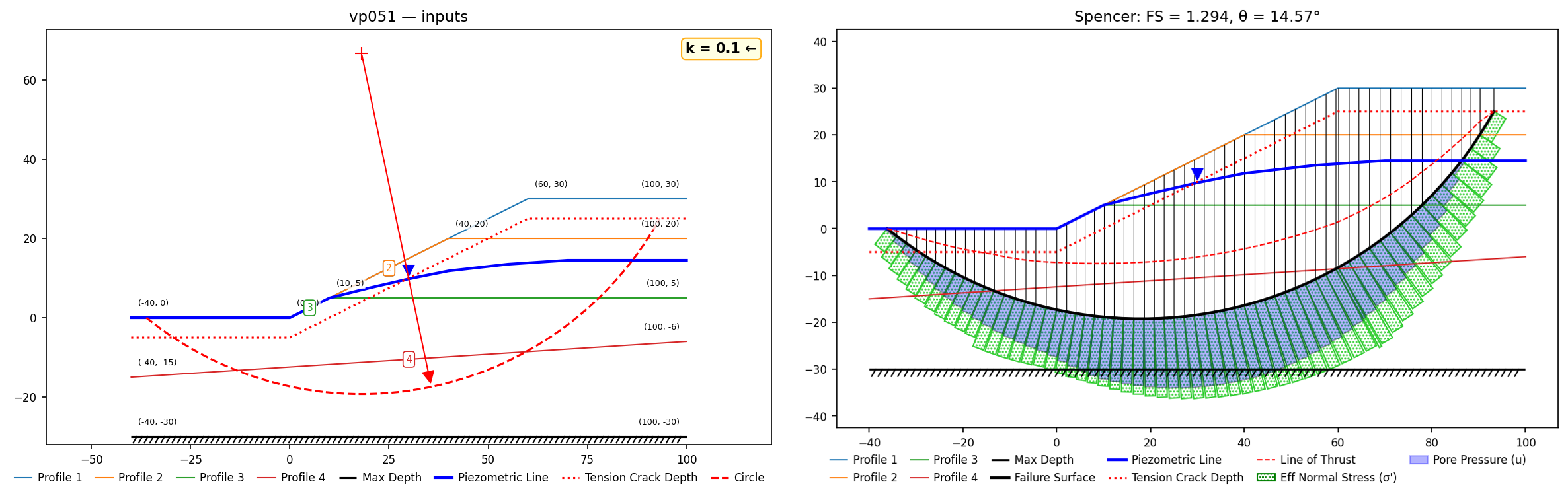
2.31 — Zhu – Four Layer Slope
Zhu, Lee & Jiang's four-layer slope with a water table, a 5 m dry tension crack, and seismic loading (k=0.1), analyzed on a specified circle. It shares the vp051.xlsx input with the Rocscience corpus, so the full geometry, material properties, and phreatic-line calibration are deferred to the linked Rocscience detail.
Input: vp051.xlsx · Rocscience detail: VP51
| Method | XSLOPE | SLOPE/W | Reference |
|---|---|---|---|
| Bishop | 1.278 | 1.284 | — |
| Spencer | 1.294 | 1.299 | — |
| Morgenstern-Price | 1.304 | 1.310 | — |
| Lowe-Karafiath | 1.296 | 1.283 | — |
| Corps of Engineers | 1.404 | 1.368 | — |
XSLOPE tracks SLOPE/W within a few thousandths across the rigorous methods (Bishop, Spencer, Morgenstern-Price), with the wider spread confined to the Lowe-Karafiath and Corps side-force assumptions.
Sources: GeoStudio SLOPE/W Verification Manual §2.31; Zhu, Lee & Jiang (2003).
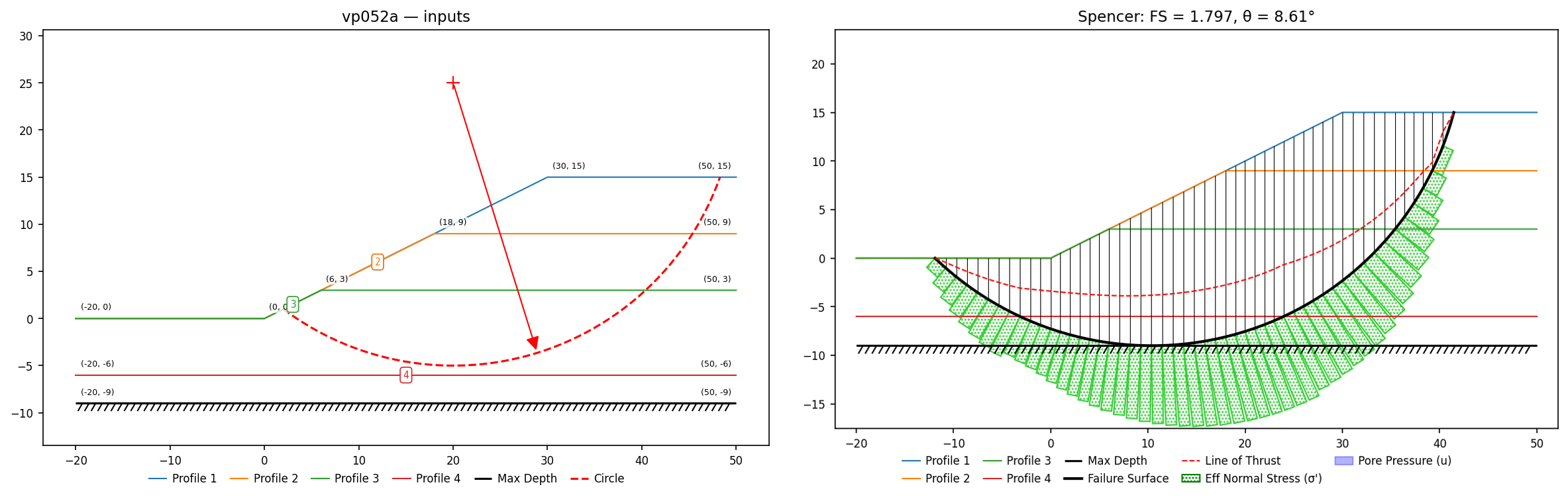
2.32 — Zhu & Lee – Heterogeneous Slope
The Zhu & Lee heterogeneous benched slope (four materials, water table, tension crack), verifying that an unconstrained circular search lands in the governing deep failure family. This shares its XSLOPE input with the Rocscience corpus (Rocscience #52) — see the linked detail for full geometry and inputs.
Input: vp052a.xlsx · Rocscience detail: VP52
| Method | XSLOPE | SLOPE/W | Reference |
|---|---|---|---|
| Spencer (wet, deep family) | 1.189 | — | Slide 1.189 |
XSLOPE's wet deep-family Spencer FS of 1.189 matches Slide exactly.
Sources: GeoStudio SLOPE/W Verification Manual §2.32; Zhu & Lee (2002).
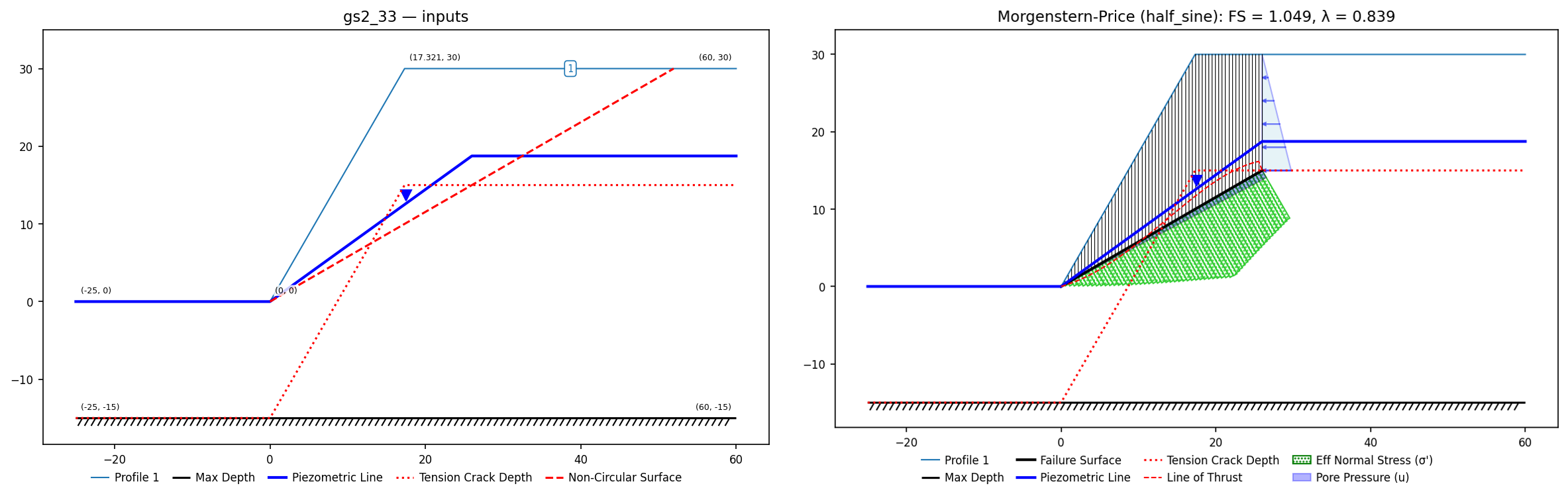
2.33 — Priest – Rigid Blocks
Priest (1993), Discontinuity Analysis for Rock Engineering: a classical rock-slope
planar failure — a single rigid block translating on one straight failure plane
(despite the section title, not a multi-block assembly) — with a 15 m tension crack at
the crest, 25% water-filled. One Mohr-Coulomb material: c′ = 20, φ′ = 30°, γ = 25. The
face rises at 60° from the toe (0, 0) to the crest (17.32, 30) with a flat crest
beyond. The failure plane dips at 30° from the toe; XSLOPE specifies it untruncated (to
its natural daylight point) and lets tcrack_depth = 15 truncate it, which reproduces
SLOPE/W's own solved endpoint (25.98, 15.0) exactly.
Input: gs2_33.xlsx
| Method | XSLOPE | SLOPE/W | Reference |
|---|---|---|---|
| Janbu | 1.049 | 1.049 | Priest (hand) 1.049 |
| Morgenstern-Price | 1.049 | 1.049 | — |
All XSLOPE methods agree to four decimals on this surface and Janbu's f₀ correction is exactly 1.00 — expected for a single straight plane, and the same behaviour the manual's FS-vs-λ figure shows for SLOPE/W (moment and force factors coincide regardless of the interslice assumption). Total sliding weight matches SLOPE/W's to 0.004%.
Sources: GeoStudio SLOPE/W Verification Manual §2.33; Priest (1993).
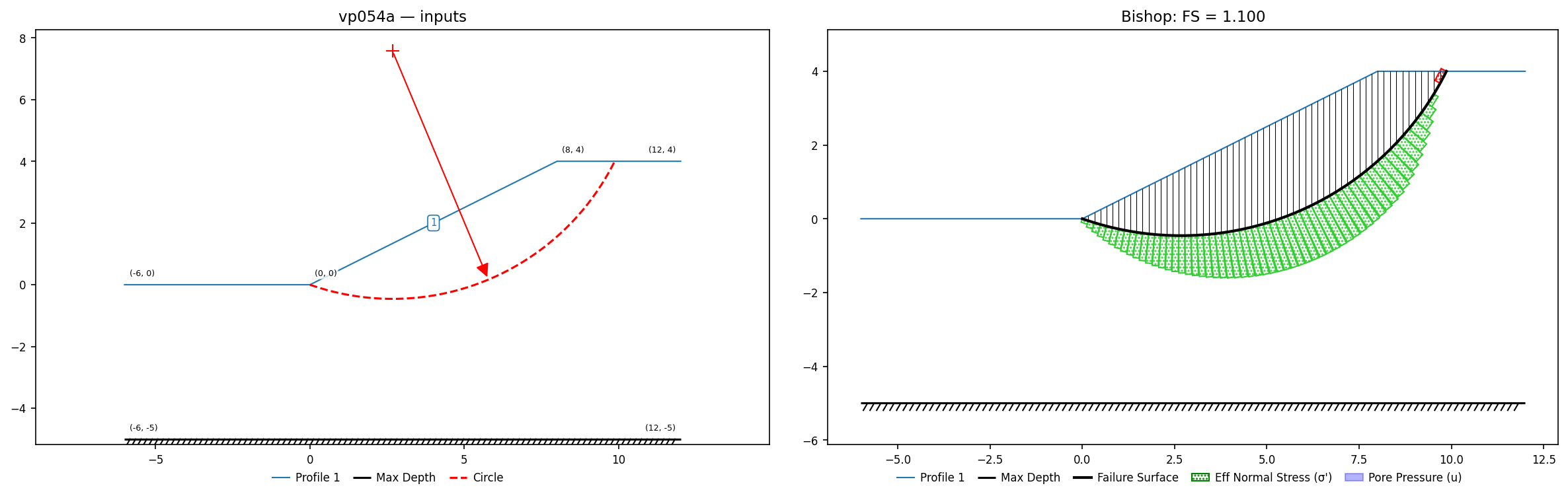
2.34 — Yamagami – Stabilizing Piles
A homogeneous slope stabilized by a row of micro-piles, verifying pile-reinforced limit equilibrium against the unreinforced baseline. It shares the XSLOPE input with the Rocscience corpus (VP54), so full geometry and material inputs are deferred to the linked Rocscience detail.
Input: vp054a.xlsx · Rocscience detail: VP54
| Method | XSLOPE | SLOPE/W | Reference |
|---|---|---|---|
| Bishop (no pile) | 1.100 | 1.102 | — |
| Bishop (with piles) | 1.185 | 1.223 | Slide 1.193; Yamagami 1.20 |
The unreinforced case matches SLOPE/W essentially exactly (1.100 vs 1.102), while the reinforced FS spreads because pile-force conventions differ program-to-program.
Sources: GeoStudio SLOPE/W Verification Manual §2.34; Yamagami.
2.35 — Pockoski & Duncan – Tie-Back Wall
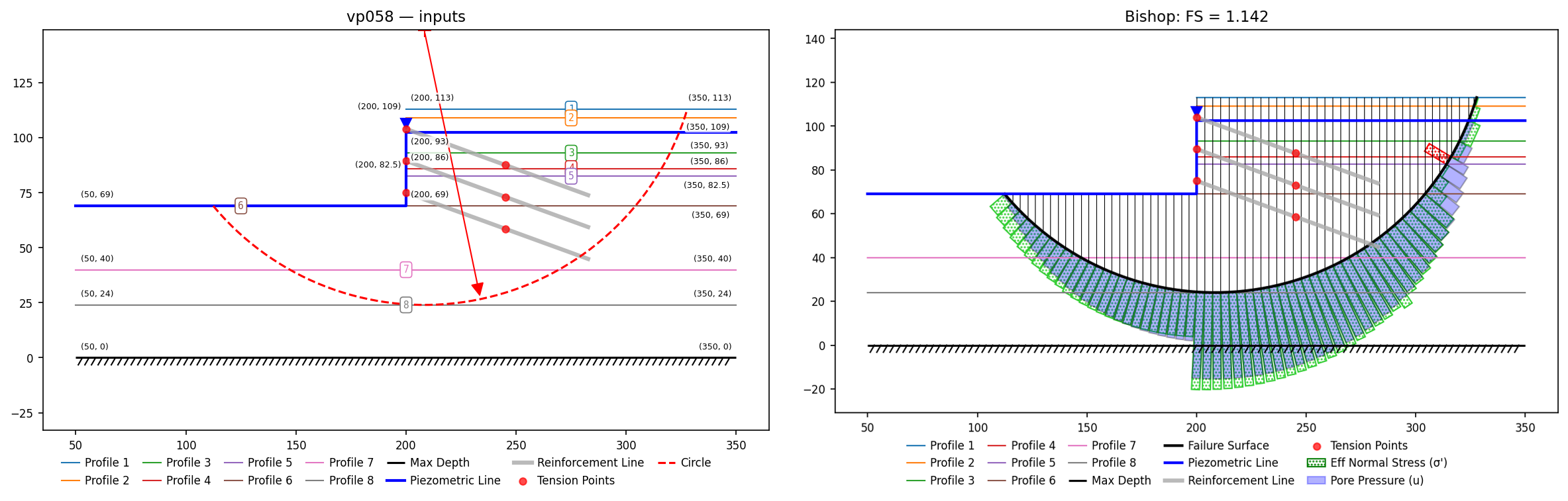
Pockoski & Duncan (2000)'s tied-back excavation wall: a 44-ft wall in eight horizontal
soil layers (granular and cohesive fills over organic silt, an over-consolidated crust,
marine clays and glaciomarine deposits), water table at grade in front and el. 102.5
behind, retained by three tieback rows at 20° whose capacity is bond-governed at 40,000
lb/ft of wall. It shares the vp058.xlsx XSLOPE input with the Rocscience corpus, so the
full geometry, layer strengths and anchor layout are deferred to the linked Rocscience
detail.
Input: vp058.xlsx · Rocscience detail: VP58
| Method | XSLOPE | SLOPE/W | Reference |
|---|---|---|---|
| Bishop | 1.142 | — (file saved unsolved) | Slide 1.147; UTEXAS4 1.14; P&D SLOPE/W 1.14 |
| Spencer | 1.140 | — | Slide 1.145; UTEXAS4 1.14 |
The vendor .gsz was saved unsolved, so SLOPE/W's own critical factor of safety is not in
the file; the SLOPE/W reference is the value Pockoski & Duncan themselves reported for it
(1.14). XSLOPE's Bishop and Spencer (1.142 / 1.140) sit within the published cluster. The
P&D (2000) report — held in the reference library — supplies the eight-layer section,
strengths and anchor capacities that de-stale this row.
Sources: GeoStudio SLOPE/W Verification Manual §2.35; Pockoski & Duncan (2000).
2.36 — Pockoski & Duncan – Reinforcement
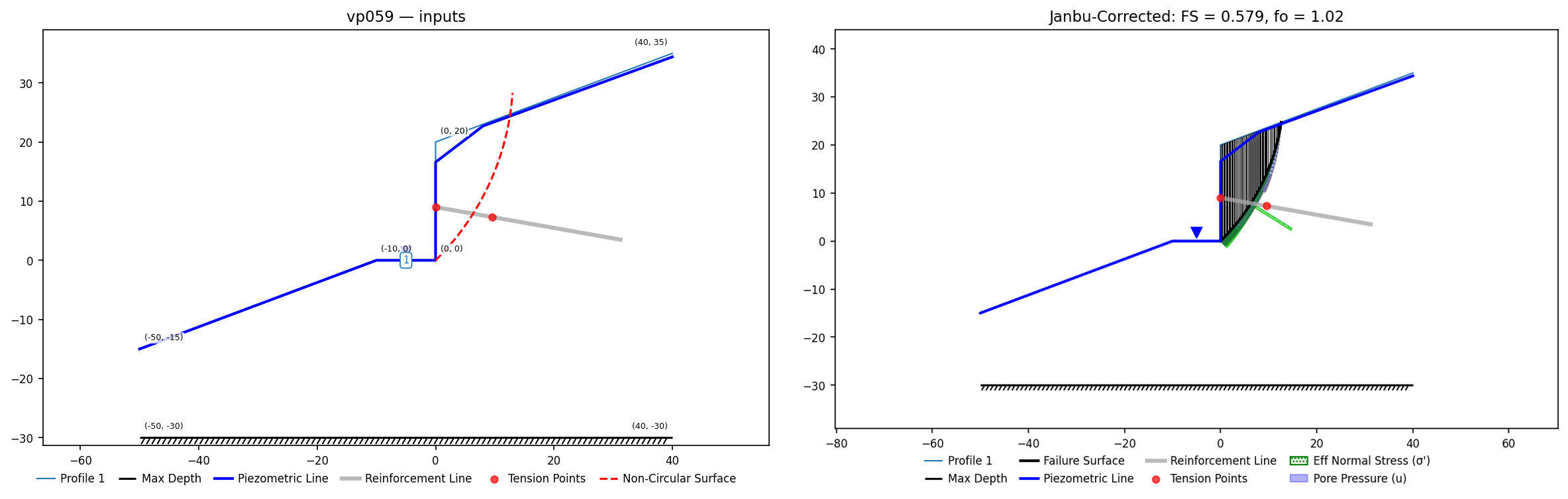
Pockoski & Duncan (2000)'s single-row tieback wall in homogeneous sand (c′ = 0, φ′ = 30°)
with the water table drawn down to the wall face — under-designed on purpose, so every
published factor of safety is below 1. It shares the vp059.xlsx XSLOPE input with the
Rocscience corpus, so the full geometry and inputs are deferred to the linked Rocscience
detail.
Input: vp059.xlsx · Rocscience detail: VP59
| Method | XSLOPE | SLOPE/W (own solve) | Reference |
|---|---|---|---|
| Janbu simplified | 0.579 | 0.575 | Slide 0.583; P&D SLOPE/W 0.61 |
| Corps / Lowe-Karafiath | 0.577 | 0.587 (Lowe) | Slide 0.588 |
XSLOPE's force-family lock (Janbu 0.579, Corps 0.577) matches SLOPE/W's own current solve (Janbu 0.575, Lowe-Karafiath 0.587) to within 1–2% — tighter than the historical inter-program spread this problem was built to expose (published Bishop values alone span 0.56–0.74). Spencer and Morgenstern-Price are inadmissible on the prescribed non-circular surface in XSLOPE (base normals near the wall go into tension), so the force-equilibrium methods carry the lock; SLOPE/W's own search rides a circular critical surface where its Spencer converges at 0.564 and Bishop at 0.531. The P&D (2000) report supplies the sand strengths, drawn-down water table and anchor layout.
Sources: GeoStudio SLOPE/W Verification Manual §2.36; Pockoski & Duncan (2000).
2.37 — Pockoski & Duncan – Soil Nails
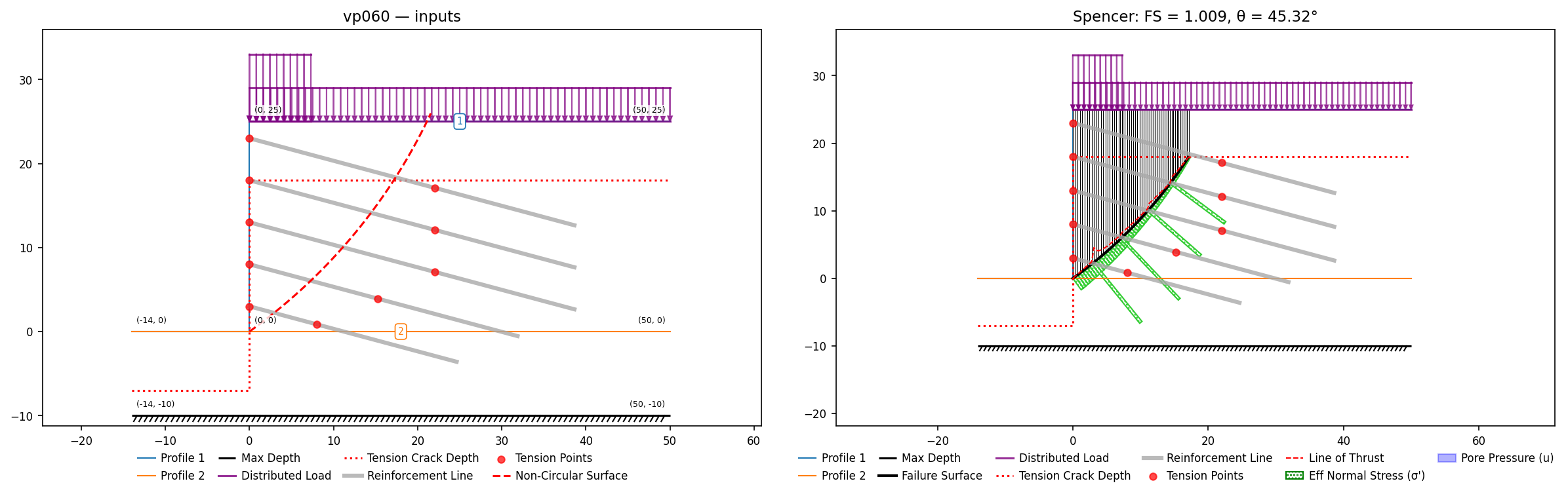
Pockoski & Duncan (2000)'s 25-ft soil-nailed wall in undrained sandy clay (c = 800 psf,
φ = 0) under a 250-psf crest surcharge plus a 500-psf strip, with a dry 7-ft tension crack
and five passive nail rows at 15°. It shares the vp060.xlsx XSLOPE input with the
Rocscience corpus, so the full geometry, surcharges and nail capacities are deferred to
the linked Rocscience detail.
Input: vp060.xlsx · Rocscience detail: VP60
| Method | XSLOPE | SLOPE/W (own solve) | Reference |
|---|---|---|---|
| Spencer | 1.010 | 1.000 | Slide 1.009; P&D SLOPE/W 1.02 |
| Janbu simplified | 1.043 | — | Slide 1.041; P&D SLOPE/W 1.07 |
| Bishop | — | 0.995 | — |
XSLOPE's Spencer (1.010) matches SLOPE/W's own solved Spencer (1.000) to 1% and Slide (1.009) essentially exactly; the nailed wall is designed for a factor of safety near 1. The P&D (2000) report supplies the surcharge pattern, tension-crack depth and five-row nail layout that de-stale this row.
Sources: GeoStudio SLOPE/W Verification Manual §2.37; Pockoski & Duncan (2000).
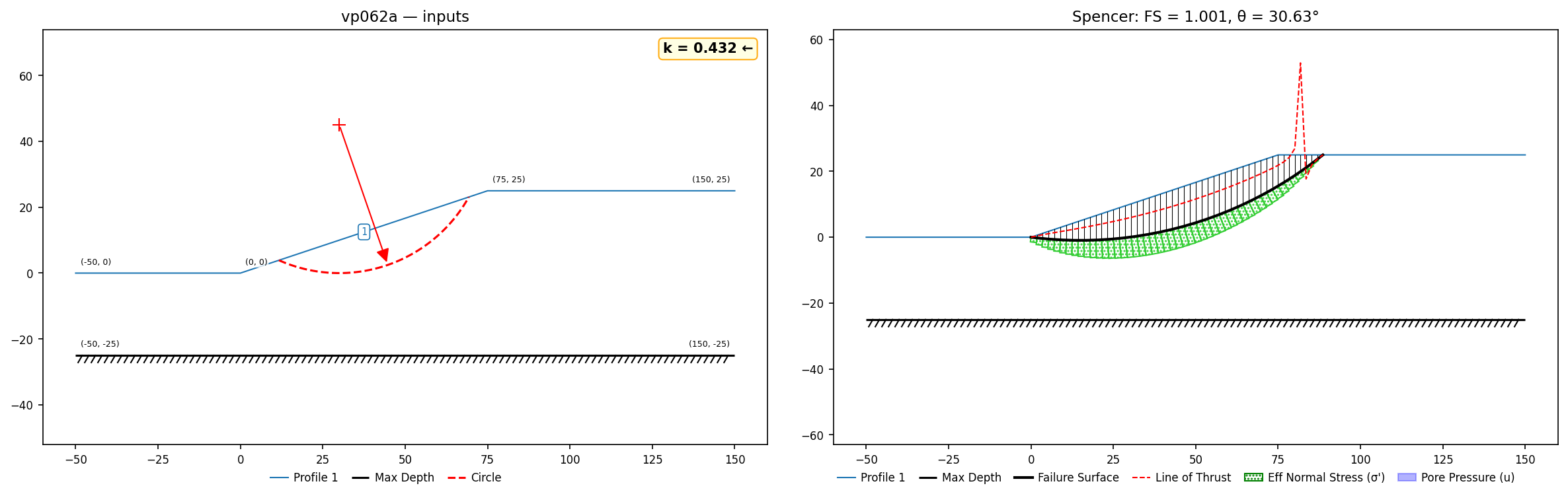
2.38 — Loukidis – Seismic Coefficient
A homogeneous slope loaded pseudo-statically at its critical seismic coefficient (dry and ru = 0.5 cases), where the factor of safety is driven to ≈ 1. It shares the XSLOPE vp062a/b inputs with the Rocscience corpus, so the full geometry and inputs are deferred to the linked Rocscience detail.
Input: vp062a.xlsx · Rocscience detail: VP62
| Method | XSLOPE | SLOPE/W | Reference |
|---|---|---|---|
| Spencer | 1.001 | 1.00 | — |
XSLOPE's Spencer factor of safety is 1.001 in both cases, matching SLOPE/W's 1.00 exactly.
Sources: GeoStudio SLOPE/W Verification Manual §2.38; Loukidis, Bandini & Salgado (2003).
2.39 — Loukidis – Seismic Coefficient #2
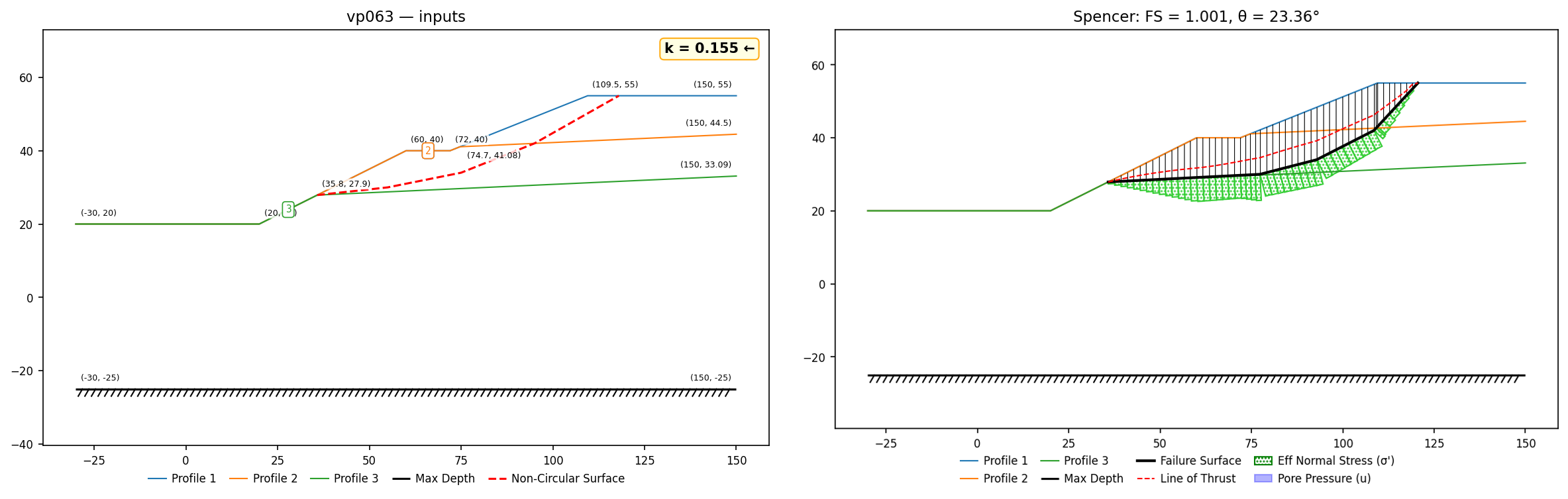
Loukidis, Bandini & Salgado (2003)'s second example: a three-layer dry slope — a light c = 4 kPa cap (φ = 30°, γ = 17), a weak c = 25 kPa / φ = 15° middle band (γ = 19) that the mechanism rides, and a strong φ = 45° base (c = 15, γ = 19). The target is not a factor of safety but the critical seismic coefficient k꜀, the horizontal pseudo-static coefficient at which the searched minimum FS = 1. It shares the Loukidis example-2 geometry with the Rocscience and RS2 corpora, so the full geometry is deferred to the linked details.
Input: vp063.xlsx · Rocscience detail: VP63 · RS2 detail (critical_kc): RS2-68 Case 3
| Target | XSLOPE | SLOPE/W | Reference |
|---|---|---|---|
| FS at the paper's k꜀ = 0.155 (Spencer) | 1.001 | — (file saved unsolved) | Loukidis 1.000 (by definition of k꜀) |
| Critical k꜀ (Spencer / Bishop) | 0.167 / 0.169 | — | Loukidis Spencer 0.155, FEM 0.161, UB 0.172 / LB 0.148; Slide2 0.151 / 0.155 |
Two locks cover this problem. VP63 fixes k at the paper's 0.155 and
confirms the slope is just stable there (noncircular Spencer 1.001). The
RS2-68 Case 3 critical_kc bisection harness instead solves for k꜀
directly and returns 0.167 (Spencer) / 0.169 (Bishop) — ~10% above the paper's 0.155
because the governing surface rides the thin φ = 15° band, which is intrinsically
non-circular, and a circular search cannot follow it as tightly as the log-spiral. The
XSLOPE values still fall inside the paper's rigorous upper/lower-bound bracket [0.148,
0.172] and sit on the reference FEM (0.161). The vendor .gsz was saved unsolved, so
SLOPE/W's own k꜀ is not in the file. The Loukidis (2003) paper — held in the reference
library — supplies the three-layer section (Fig. 9(a): a 15 m upper block over a 20 m
lower face, φ = 15° band) and Table 3's k꜀ values that de-stale the "interface anchors
ambiguous" note.
Sources: GeoStudio SLOPE/W Verification Manual §2.39; Loukidis, Bandini & Salgado (2003).
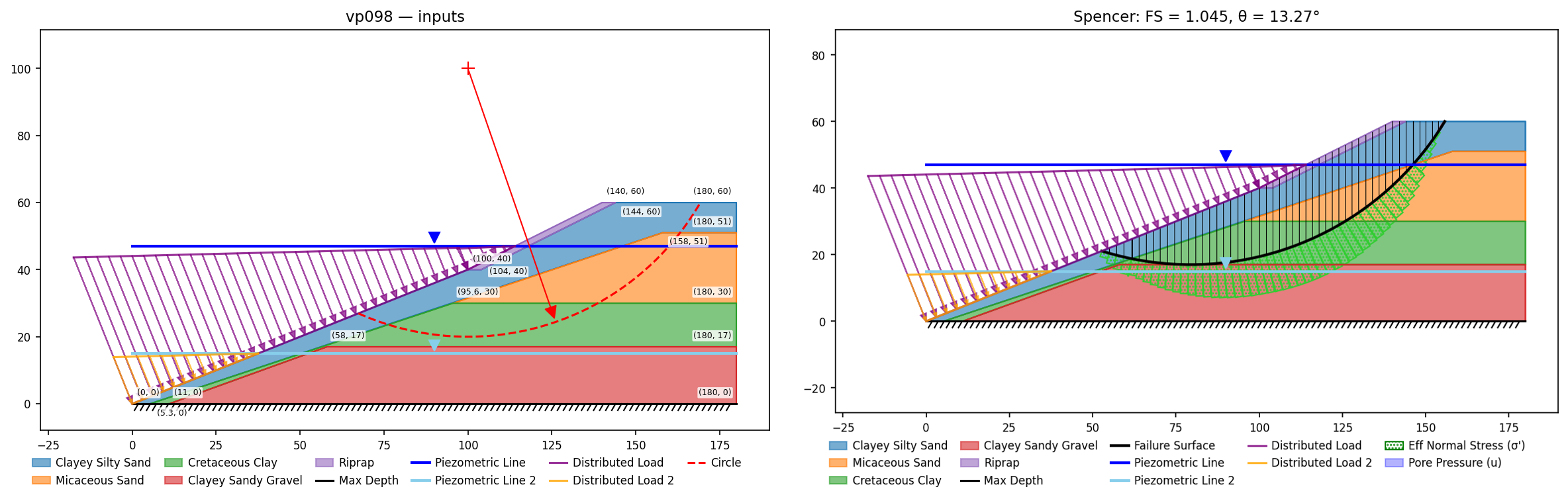
2.40 — Rapid Drawdown – Walter Bouldin Dam
The Walter Bouldin Dam is a rolled earthfill dam that failed during a rapid drawdown in 1975; this case verifies XSLOPE's Duncan-Wright-Wong three-stage rapid drawdown procedure. It shares the vp098.xlsx input with the Rocscience corpus, so the full geometry, zones, and undrained envelopes are deferred to the linked Rocscience detail.
Input: vp098.xlsx · Rocscience detail: VP98
| Method | XSLOPE | SLOPE/W | Reference |
|---|---|---|---|
| DWW 3-stage (Spencer) | 1.046 | 1.02 | 1.04 |
| DWW 3-stage (Bishop) | — | 1.016 | — |
XSLOPE's DWW three-stage FS (1.046, Spencer circular search) agrees with SLOPE/W's Spencer (1.02) and the published DWW value (1.04) to within about 1%, and brackets SLOPE/W's Bishop result (1.016).
Sources: GeoStudio SLOPE/W Verification Manual §2.40; Duncan, Wright & Wong (1990).
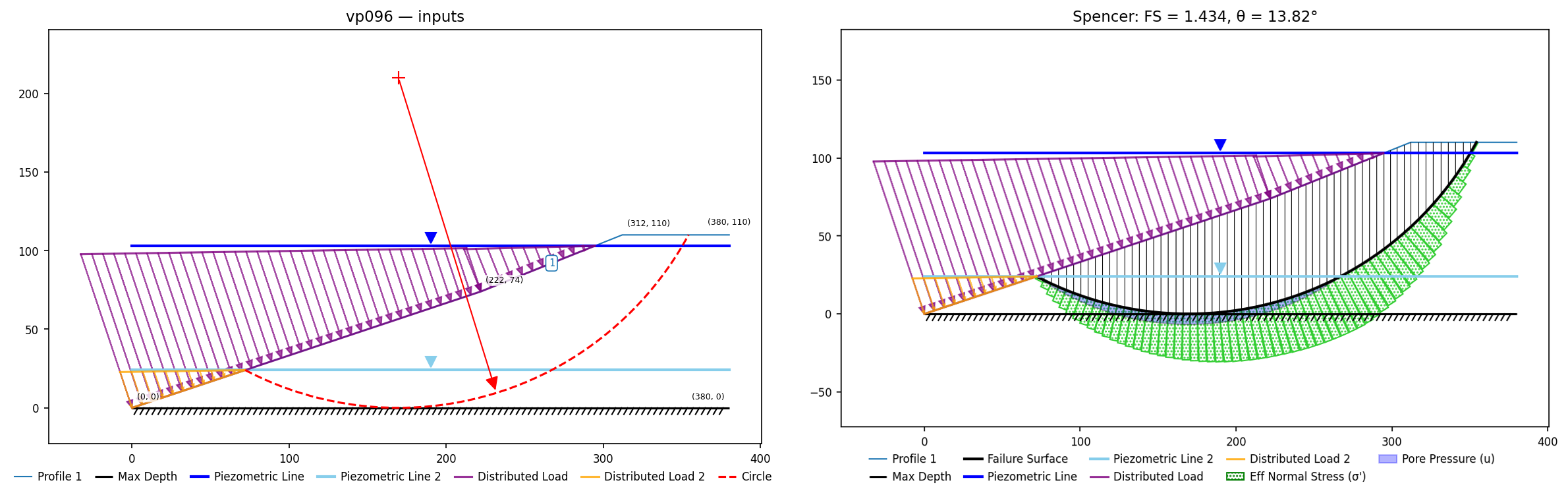
2.41 — Rapid Drawdown – USACE Benchmark
A homogeneous embankment dam rapid-drawdown benchmark from USACE EM 1110-2-1902 (2003) Appendix G, evaluated with the Duncan-Wright-Wong 3-stage procedure on the specified circle. It shares the XSLOPE input vp096.xlsx with the Rocscience corpus, so full geometry and material inputs are deferred to the linked Rocscience detail.
Input: vp096.xlsx · Rocscience detail: VP96
| Method | XSLOPE | SLOPE/W | Reference |
|---|---|---|---|
| Bishop | 1.432 | — | 1.44 |
| Spencer | 1.434 | — | 1.44 |
XSLOPE's 3-stage Spencer (1.434) and Bishop (1.432) both agree with the published USACE benchmark of 1.44 to within about half a percent.
Sources: GeoStudio SLOPE/W Verification Manual §2.41; USACE EM 1110-2-1902 (2003) Appendix G (Duncan, Wright & Wong 3-stage procedure).
2.42 — Rapid Drawdown – Pumped Storage Dam
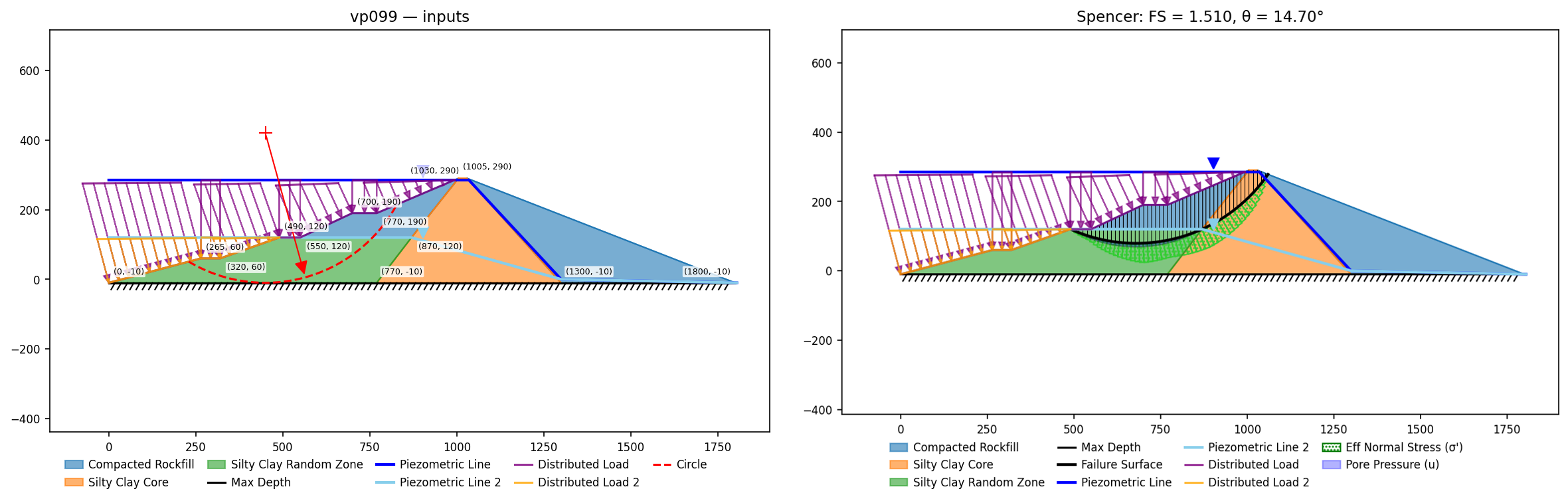
Rapid drawdown (285 → 120 ft) of a hypothetical pumped-storage dam — silty-clay core and free-draining rockfill shells — analyzed with the Duncan-Wright-Wong 3-stage procedure. It shares its XSLOPE input with the Rocscience corpus (VP99), so the full geometry and material inputs are deferred to the linked Rocscience detail.
Input: vp099.xlsx · Rocscience detail: VP99
| Method | XSLOPE | SLOPE/W | Reference |
|---|---|---|---|
| Spencer (DWW 3-stage) | 1.527 | 1.550 | 1.56 |
The geometry is re-pinned from this very .gsz (read with xslope.geostudio.read_gsz); the earlier eyeball trace of Slide's unlabeled figure had made the dam ≈19 ft short and left XSLOPE ~7% low. With the vendor geometry XSLOPE reads 1.527, inside the Slide / SLOPE/W / DWW band (1.53–1.56).
Sources: GeoStudio SLOPE/W Verification Manual §2.42; Duncan, Wright & Wong (1990).
2.43 — Rapid Drawdown – Pilarcitos Dam
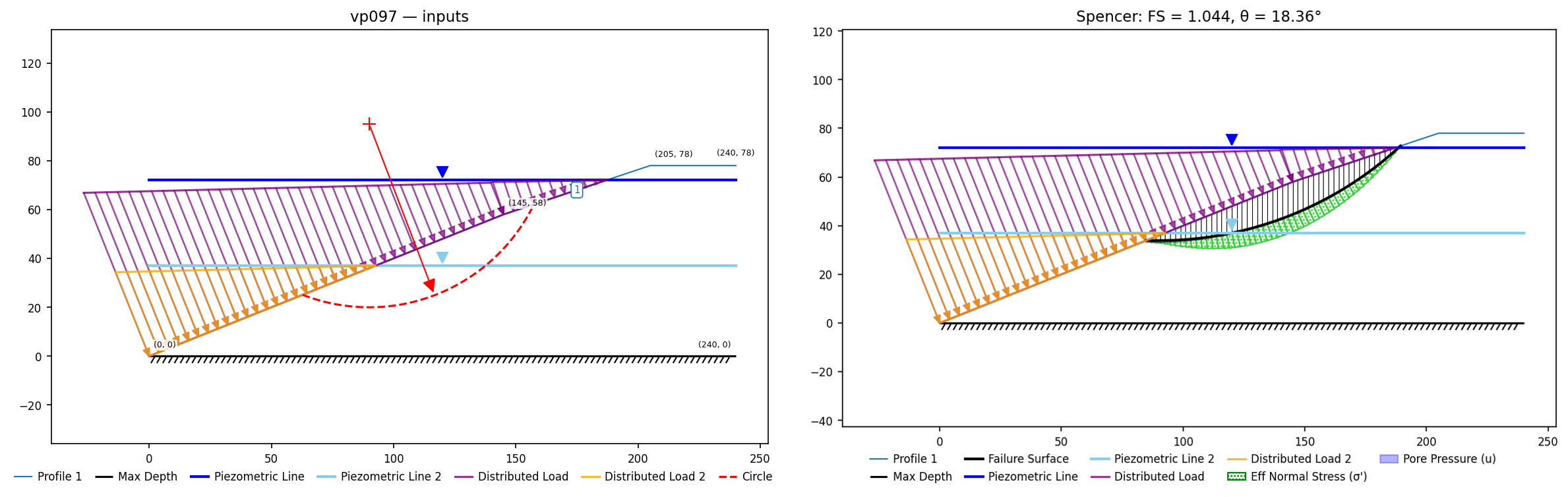
A three-stage rapid-drawdown analysis of Pilarcitos Dam — a homogeneous earthfill embankment (Duncan, Wright & Wong 1990) drawn down from 72 to 37 ft, a documented drawdown-failure case. It verifies XSLOPE's staged drawdown procedure and shares its XSLOPE input with the Rocscience corpus, so the full geometry and strength envelopes are deferred to the linked Rocscience detail (VP97).
Input: vp097.xlsx · Rocscience detail: VP97
| Method | XSLOPE | SLOPE/W | Reference |
|---|---|---|---|
| Bishop | 1.042 | — | — |
| Spencer | 1.044 | — | — |
XSLOPE's Spencer (1.044) and Bishop (1.042) staged factors of safety are essentially identical; the geostudio entry reports the shared VP97 XSLOPE run, with the published Slide and Duncan–Wright–Wong reference values documented in the linked Rocscience detail.
Sources: GeoStudio SLOPE/W Verification Manual §2.43; Duncan, Wright & Wong (1990).
2.45 — Eurocode 7: Cutting in Clay
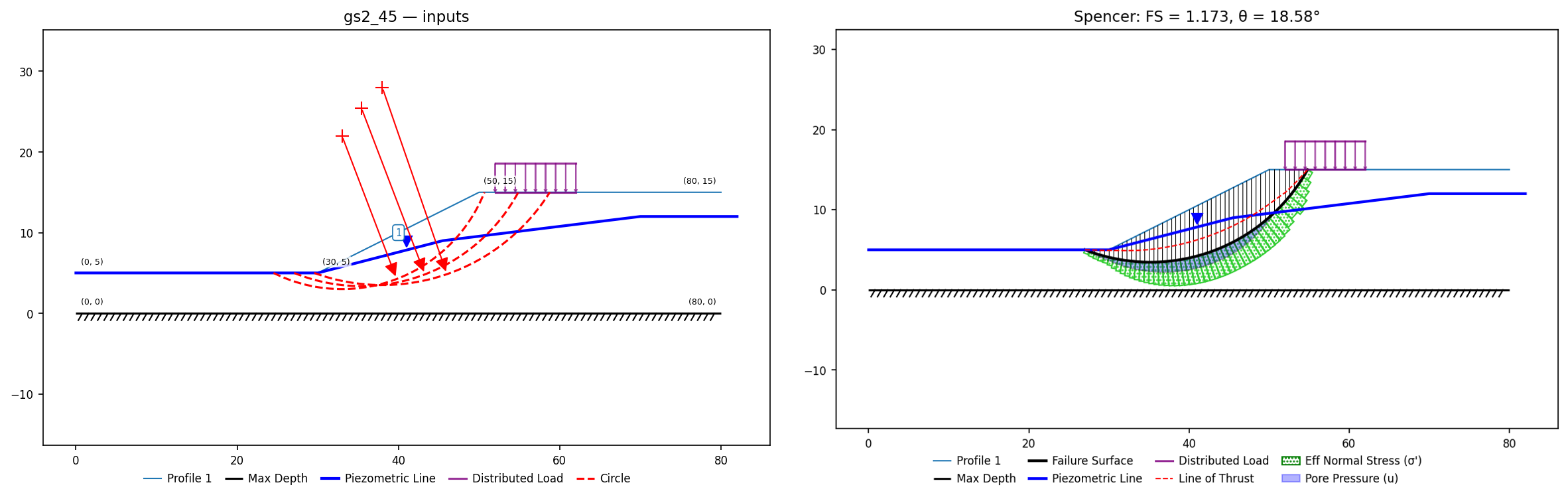
A 1:2 cutting in a homogeneous clay (characteristic c′ = 10, φ′ = 28°, γ = 20) with a water table and a 35 kPa permanent crest surcharge, checked to Eurocode 7 Design Approach 3 (after the Designers' Guide to Eurocode 7). XSLOPE has no native partial-factor feature, so the DA3 material factors (set M2) are baked into the authored material — c′ = 10/1.25 = 8.0 kPa, φ′ = atan(tan 28°/1.25) = 23.04° — with soil weight and the permanent surcharge at their factor of 1.0. An ordinary analysis of the factored model then reproduces GeoStudio's Overdesign Factor (ODF).
Input: gs2_45.xlsx
| Method | XSLOPE | SLOPE/W (ODF) | Reference |
|---|---|---|---|
| Spencer | 1.173 | 1.174 | book (Bishop) 1.193 |
| Bishop | 1.172 | 1.173 | — |
XSLOPE's Spencer ODF matches SLOPE/W's to −0.07%, and on SLOPE/W's own critical circle the two agree to −0.09% — the factored-parameter emulation reproduces the EC7 design check at method level. Janbu is not compared (XSLOPE reports the f₀-corrected value; the manual's column is uncorrected).
Sources: GeoStudio SLOPE/W Verification Manual §2.45; Designers' Guide to Eurocode 7.
2.46 — Eurocode 7: Earth Dam
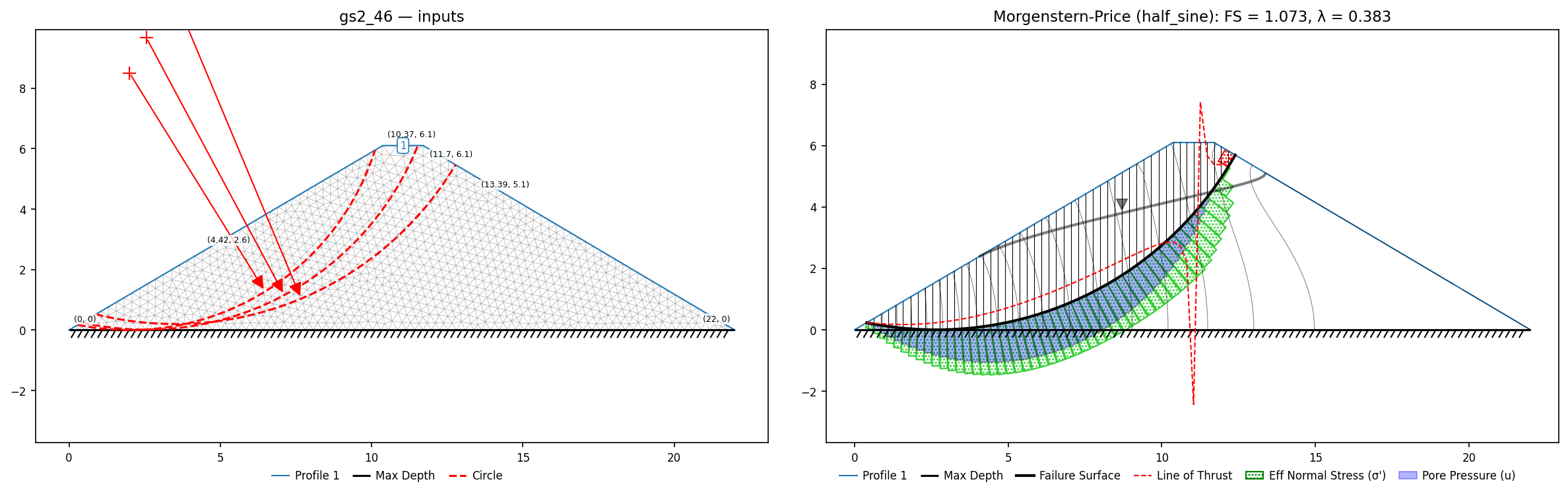
A homogeneous clay dam (characteristic c′ = 12, φ′ = 20°, γ = 19.2) with an upstream reservoir at 5.1 m total head, analysed as coupled steady-state seepage + slope stability under Eurocode 7 Design Approach 1, Combination 2 (after Smith's Elements of Soil Mechanics, ex. 5.12). Pore pressures come from an XSLOPE finite-element seepage solve (u = 'seep' with mesh/solution sidecars) whose phreatic surface reproduces SEEP/W's to ~0.1–0.2 m; the DA1-C2 material factors (set M2) are baked in — c′ = 9.6 kPa, φ′ = 16.23° — so an ordinary analysis yields the Overdesign Factor.
Input: gs2_46.xlsx (+ gs2_46_mesh.json,
gs2_46_seep.csv)
| Method | XSLOPE | SLOPE/W (ODF) | Reference |
|---|---|---|---|
| Morgenstern-Price | 1.073 | 1.091 | book (Bishop) 1.07 |
| Bishop | 1.074 | 1.092 | — |
On SLOPE/W's own critical circle XSLOPE's Morgenstern-Price (1.099) matches SLOPE/W (1.101) to −0.2%; XSLOPE's free search finds a slightly more critical downstream surface at 1.073, landing on the Smith textbook value (1.07), where SLOPE/W reports its base-truncated composite minimum at 1.091 — a search-coverage difference, not a model one. Janbu is not compared (corrected vs uncorrected convention).
Sources: GeoStudio SLOPE/W Verification Manual §2.46; Smith's Elements of Soil Mechanics (8th ed.), ex. 5.12.