XSLOPE
Beta — under active development
xslope is still in development mode: changes land daily, interfaces and input templates may shift between releases, and results should be independently verified before use in practice. We hope to formally issue version 1.0 soon. Feedback and issue reports are welcome in the meantime.
xslope is a comprehensive Python package for geotechnical slope stability and seepage analysis. Available on PyPI and github, it provides integrated tools for limit equilibrium slope stability analysis, finite element seepage analysis, and finite element-based slope stability analysis. The package uses an Excel-based input template system, making it accessible to practitioners familiar with spreadsheet workflows while leveraging the power of Python for computational analysis and visualization. For users who prefer a graphical workflow, the companion desktop application XSlope Studio wraps the same engine in a point-and-click interface — open a problem, edit it graphically, run every analysis, and view results without writing code.
The xslope software was developed by Norman L Jones, PhD, a professor in the Civil and Construction Engineering Department at Brigham Young University and the founder and principal of Jones Geoscience LLC. Prof. Jones earned his PhD at the University of Texas where his PhD advisor was the world-renowned slope stability expert, Stephen G. Wright. He has been on the faculty at BYU since 1991 where he has taught CE 544 - Seepage and Slope Stability Analysis. This course curriculum is built around the xslope software and is publicly available here.
XSlope Studio — Desktop Application
XSlope Studio is a cross-platform desktop application that brings the full xslope engine into a graphical, point-and-click workflow. Open an Excel problem and see its geometry rendered; edit every input through forms, tables, or by double-clicking a feature on the canvas; build a mesh and run limit-equilibrium, seepage, and finite-element analyses; and review the results across dedicated views — all without writing a line of code. Studio reads and writes the same Excel format as the library, so files move freely between Studio, scripts, and notebooks. A built-in AI assistant can build inputs from a sketch, run parametric studies, and explain results in natural language.
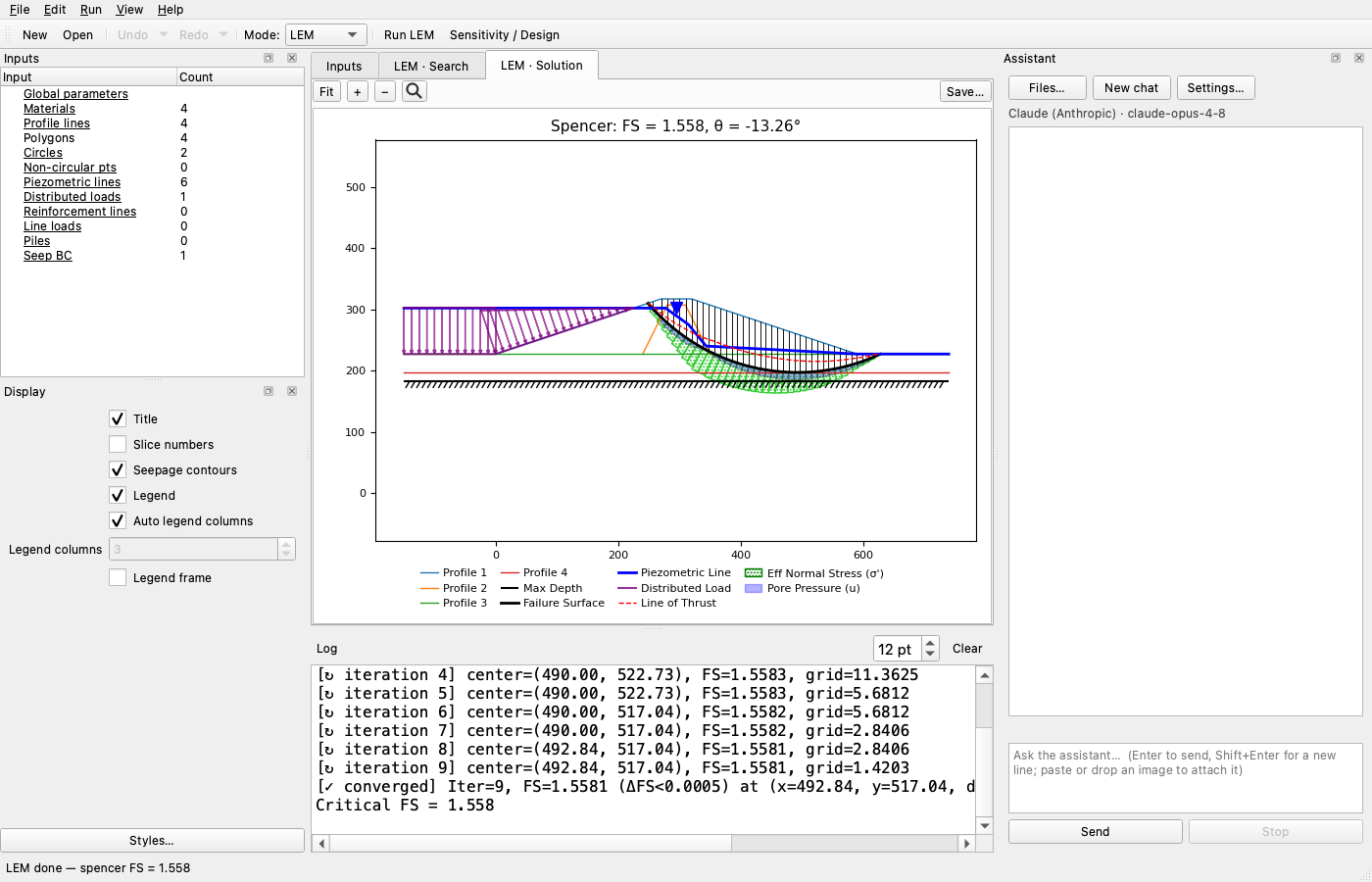
See the XSlope Studio section for installation, a tour of the interface, editing, running analyses, and the AI assistant.
Limit Equilibrium Slope Stability Analysis
The limit equilibrium method (LEM) represents the fundamental approach to slope stability analysis, evaluating stability by examining the equilibrium of forces acting on a potential failure mass. A slope remains stable when the resisting forces, primarily the shear strength of the soil along the failure surface, exceed the driving forces such as weight and other destabilizing influences. The factor of safety is expressed as the ratio of available shear strength to the shear stress required for equilibrium.
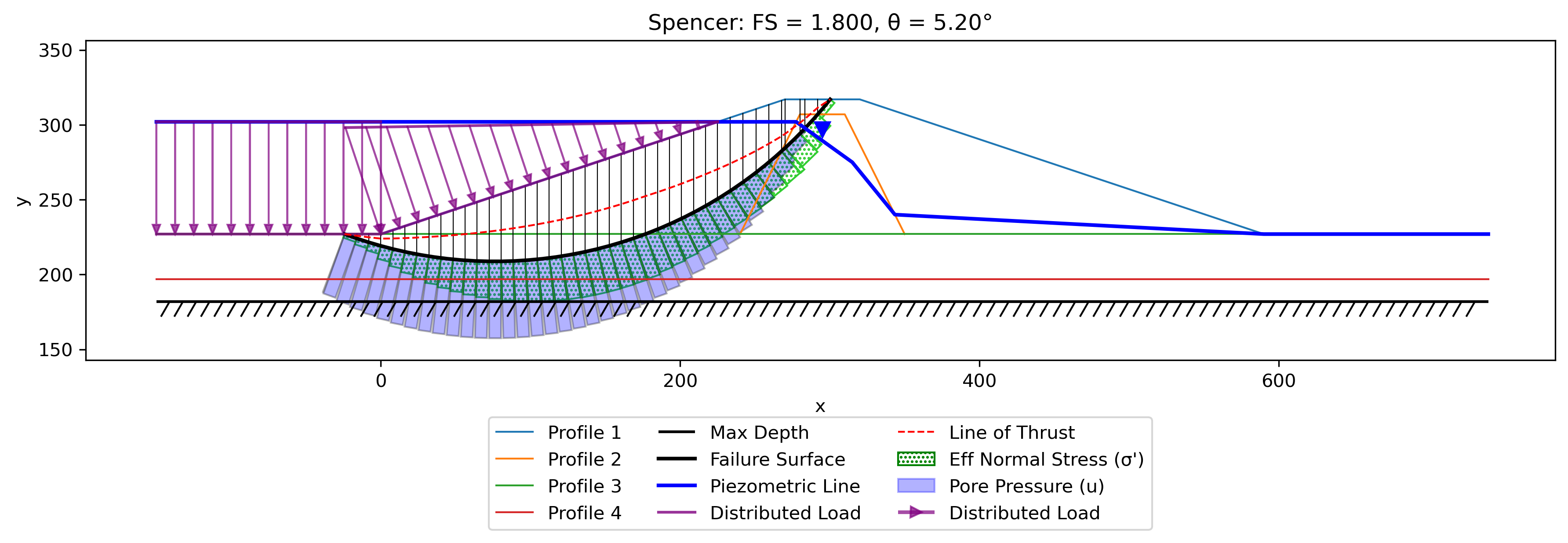
xslope employs the method of slices, a numerical technique that divides the potential failure mass into a series of vertical slices. Rather than analyzing the entire mass as a single unit, each slice is examined individually, with the overall stability determined by summing the forces and moments acting on all slices. This approach allows for the analysis of complex geometries, varying soil conditions, and multiple loading scenarios including distributed surface loads, seismic forces, reinforcement, and tension cracks.
The package implements seven distinct limit equilibrium methods, each with different assumptions about inter-slice forces and equilibrium conditions:
- Ordinary Method of Slices (OMS) - The simplest approach, satisfying only moment equilibrium with no iteration required. Best for preliminary analysis where speed is prioritized over accuracy.
- Simplified Janbu Method - Satisfies horizontal force equilibrium with an empirical correction factor. Suitable for both circular and non-circular failure surfaces.
- Bishop's Simplified Method - The most widely used method, satisfying moment and vertical force equilibrium. Provides good accuracy for circular failure surfaces with reasonable computational efficiency.
- Corps of Engineers Method - A force equilibrium approach assuming horizontal inter-slice forces. Applicable to any failure surface geometry.
- Lowe & Karafiath Method - Similar to Corps Engineers but with inter-slice forces oriented at the average of the slope and failure surface angles. Particularly effective for seismic loading analysis.
- Spencer's Method - A rigorous approach satisfying complete force and moment equilibrium simultaneously with a constant inter-slice force inclination. Generally considered one of the most accurate methods available in xslope.
- Morgenstern–Price Method - The most general complete-equilibrium method and a generalization of Spencer's: it satisfies full force and moment equilibrium while letting the inter-slice force inclination vary along the surface according to a chosen function, \(\tan\theta(x) = \lambda f(x)\) (constant, which reproduces Spencer, or a half-sine default). Applicable to both circular and non-circular surfaces.
Beyond single surface analysis, xslope includes automated search algorithms that systematically evaluate thousands of candidate failure surfaces to identify the critical surface with the minimum factor of safety. These search capabilities use adaptive grid refinement to efficiently locate critical surfaces for both circular and non-circular geometries. The package also supports rapid drawdown analysis for dams and levees, as well as reliability analysis using Monte Carlo methods to compute probability of failure based on input parameter uncertainties.
Finite Element Seepage Analysis
Pore water pressures play a critical role in slope stability, yet they are rarely uniform or static in natural slopes. Traditional approaches such as estimating pore pressures using depth below a piezometric line often fail to capture the complex groundwater flow patterns that develop in heterogeneous soil profiles with varying permeabilities and complex boundary conditions. xslope addresses this challenge by providing comprehensive finite element seepage analysis capabilities that solve the complete groundwater flow equation throughout the slope domain. The package generates finite element meshes directly from the slope geometry defined in the Excel template, computes spatially varying pore pressure fields that accurately reflect site-specific hydrogeological conditions, and seamlessly integrates these results into slope stability calculations. Both saturated and unsaturated flow problems can be simulated, with the system automatically selecting the appropriate solution algorithm based on boundary conditions.
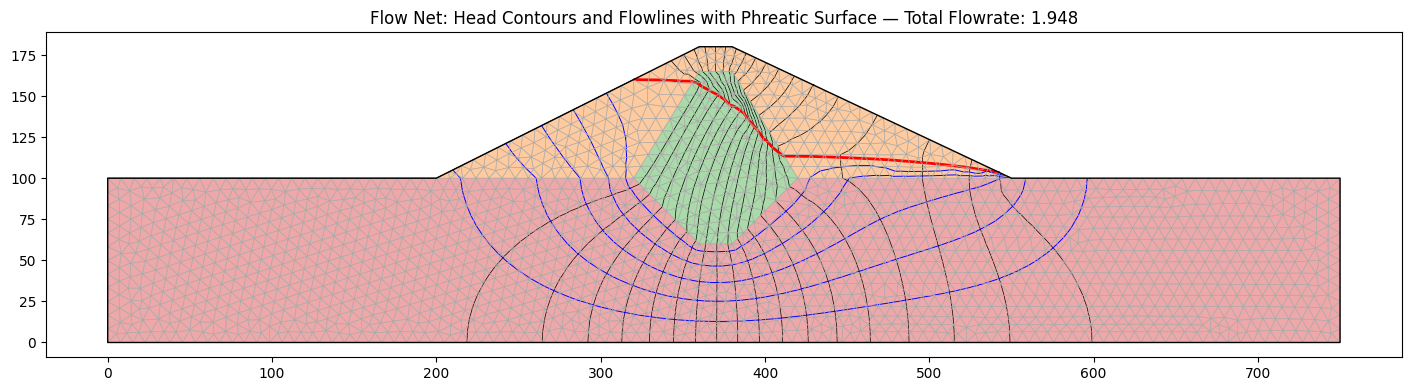
Beyond slope stability applications, xslope can be used as a standalone 2D groundwater flow analysis package for a wide range of seepage problems. This includes analysis of earth dams, excavations, foundation seepage, flow under sheetpiles, and other civil engineering applications where groundwater flow patterns need to be characterized. The Excel template-based workflow makes it straightforward to set up complex seepage problems with multiple material zones and boundary conditions.
Finite Element Slope Stability Analysis
The finite element method (FEM) provides a powerful numerical approach to slope stability analysis that overcomes fundamental limitations of traditional limit equilibrium methods. While limit equilibrium approaches require engineers to assume a failure surface geometry and then verify equilibrium, FEM allows potential failure mechanisms to emerge naturally through rigorous stress-strain analysis. Rather than imposing kinematic constraints through assumed failure surfaces, FEM solves the complete stress-strain problem throughout the slope domain, capturing complex stress redistribution as soil elements progressively reach failure and allowing failure zones to develop naturally without prior assumptions about their geometry or location.
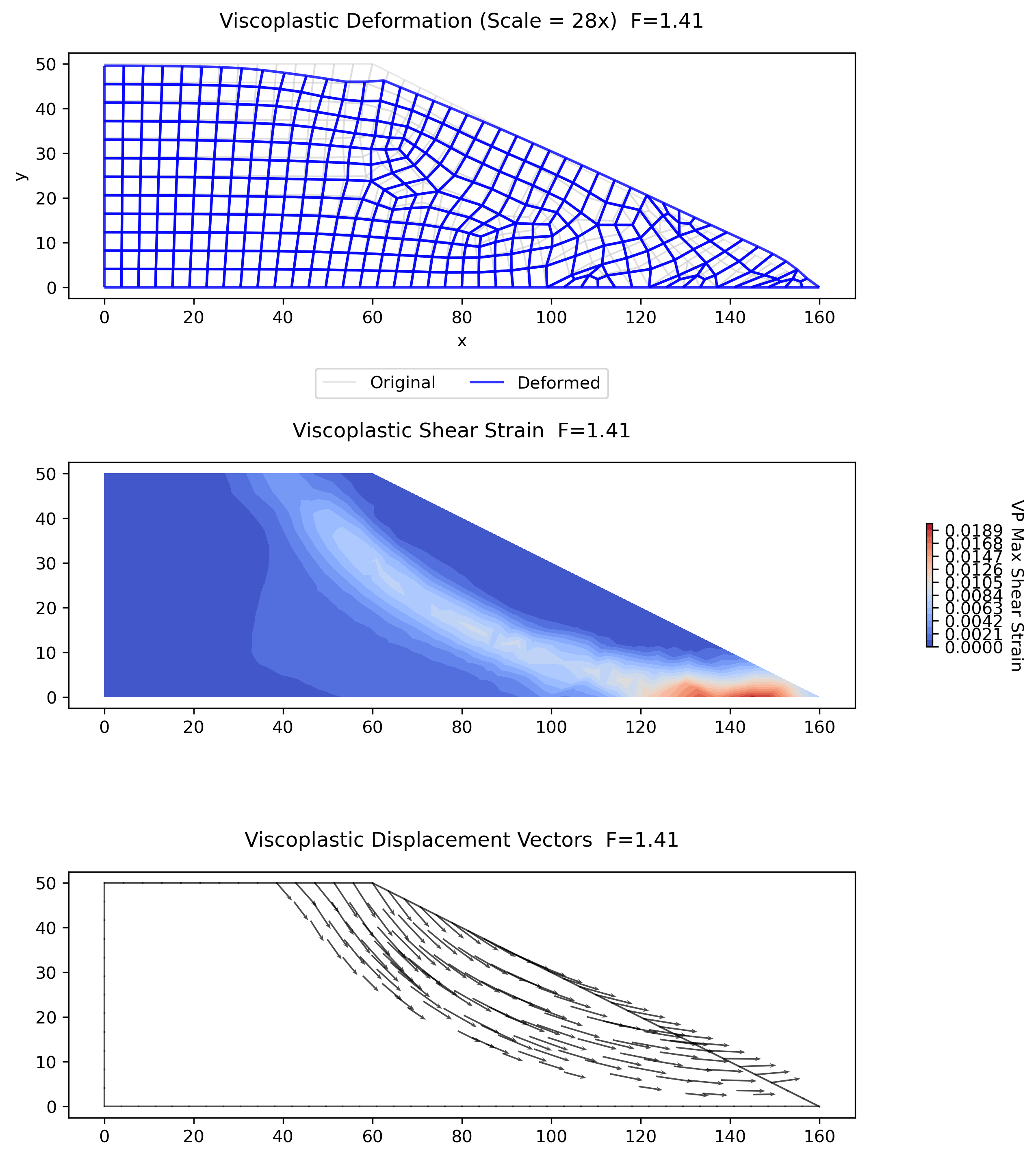
xslope implements finite element slope stability analysis using an elastic-perfectly plastic constitutive model with Mohr-Coulomb failure criterion. The Shear Strength Reduction Method (SSRM) is employed to determine the factor of safety by systematically reducing soil shear strength parameters until the slope can no longer maintain equilibrium. This approach provides a rigorous and theoretically sound alternative to limit equilibrium methods while maintaining a consistent definition of factor of safety.
The finite element implementation seamlessly integrates with xslope's existing seepage analysis capabilities, enabling coupled stress-seepage analysis for slopes under varying groundwater conditions. Soil reinforcement systems including geotextiles, soil nails, and ground anchors are modeled using embedded truss elements that capture both material tensile strength and pullout resistance. Seismic loading is incorporated through the pseudo-static method, representing earthquake forces as equivalent static body forces throughout the slope mass.
All finite element analysis capabilities use the same Excel input template system as the limit equilibrium and seepage modules, with additional material properties (Young's modulus, Poisson's ratio) and reinforcement parameters (cross-sectional area, elastic modulus, pullout lengths) specified in dedicated columns of the existing tables. This unified input framework ensures consistency across all analysis types while minimizing the learning curve for users already familiar with xslope's limit equilibrium capabilities.
Licensing
xslope is released as open source software under the Apache License 2.0, a permissive license that allows both commercial and private use while fostering collaboration and innovation in the geotechnical engineering community. The Apache license grants users the freedom to use, modify, and distribute the software with minimal restrictions, requiring only preservation of copyright and license notices. It provides express patent protection, ensuring contributors grant patent rights to users, and allows derivative works to be distributed under different terms. This licensing approach encourages widespread adoption in both academic research and professional practice while maintaining attribution to the original developers.